
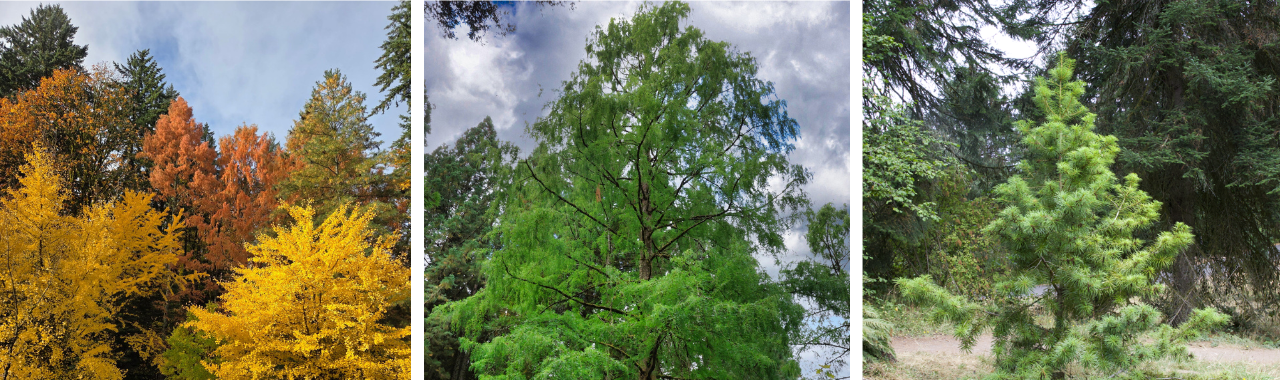
Attend a few guided hikes at Hoyt Arboretum and if you’re like me, you might notice that some of the Chinese trees in the collections seem like they belong in an Indiana Jones movie.
Indiana Jones and the Kingdom of the Living Fossils
“This rare tree grew from a seed smuggled out of China…” (Cathaya argyrophylla)
“Everyone believed this tree had been extinct for millions of years, until it was rediscovered in rural China, where it was revered by the village elders as the abode of a god.” (Metasequoia glyptostroboides)
“These trees were thought extinct, until a grove tended by Buddhist monks was found in China…” (Ginkgo biloba)
Why does China have so many “living fossils”?
China’s enormous variety of habitats – lowlands, high plateaus, tropical coasts, dry grasslands, and mountains – created relatively stable pockets where ancient trees could survive even as they vanished from the rest of the world.
These “living fossils” are species we know from the fossil record that still grow today. Take a minute to let that sink in.
You can visit Hoyt Arboretum today and touch trees whose ancestors lived with the dinosaurs.
Hoyt Arboretum’s collections include 67 taxa from China. At least three of them have especially cinematic stories, and you can visit them all on a short walk.
The Temple of Dawn
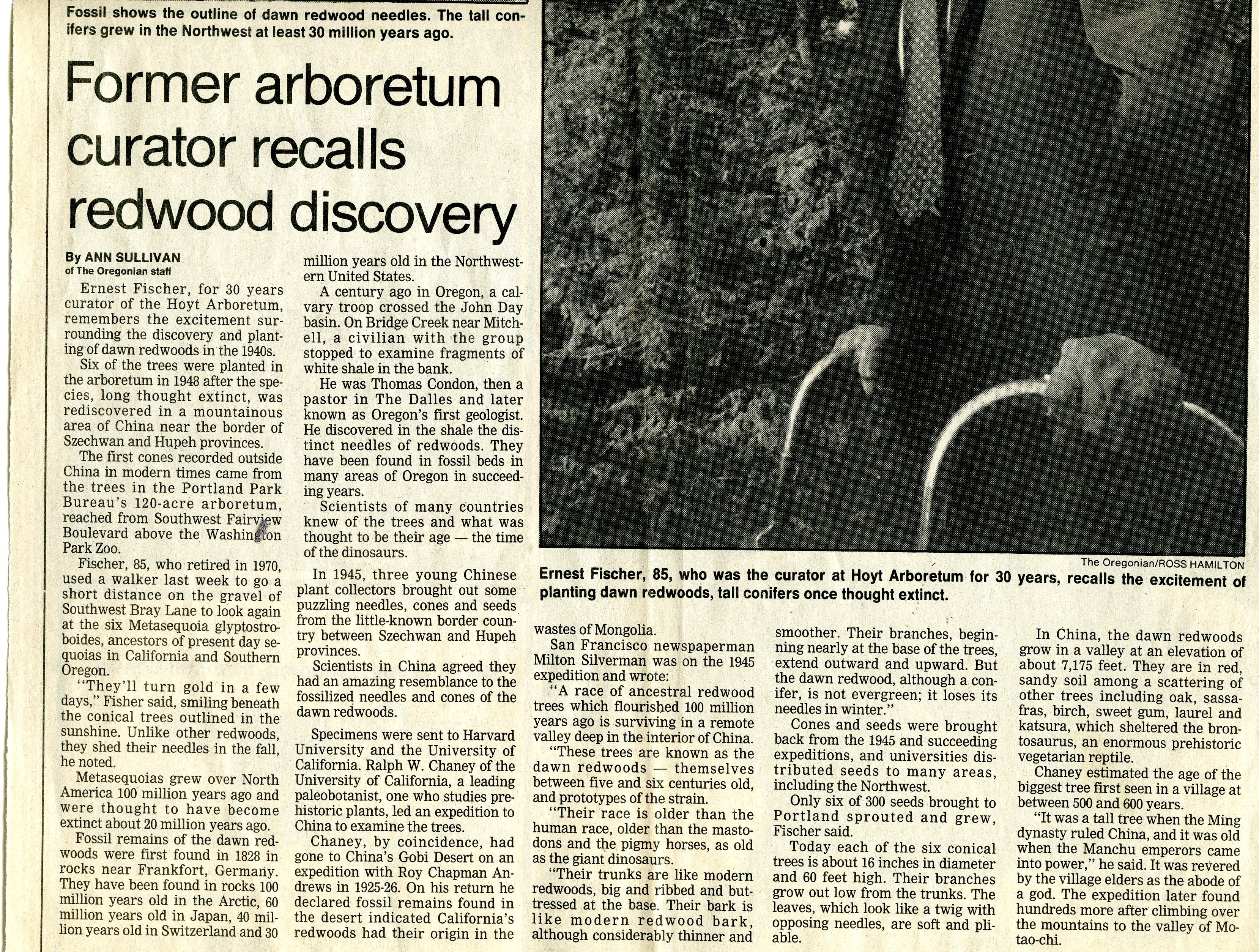
The dawn redwood, once widespread across the Northern Hemisphere, was believed extinct for 6-8 million years. That is, until it was rediscovered in China.
Picture this: it’s 1941 and a Chinese Forestry professor is hiking in a remote valley, deep in the interior of China. As he reaches an isolated village, he looks up and sees something that shouldn’t exist.
A giant tree he only knows from the fossil record is standing before him. The villagers have built a shrine around it, because they believe a god dwells within.
Restoring a species
Despite the amazing nature of this discovery, World War 2 delayed further examination and study. But after the war, Harvard University gathered adventurous scientists and funded a successful seed-collecting expedition.
In the late 1940’s those seeds were distributed to botanical gardens and arboreta around the country, including Hoyt.
“It belongs in a museum”
The dawn redwood is an ancient relic, one that Doctor Henry Walton Jones, Jr. would insist belongs in a museum. And that’s exactly where it is. North America’s first viable specimen of dawn redwood sprouted right here in Hoyt Arboretum, and now stands as a crown jewel in Hoyt’s living museum of trees.
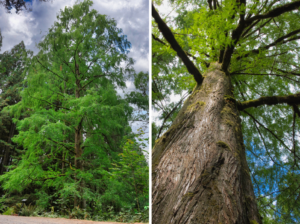
The dawn redwood is now the official Oregon state fossil.
The legend lives on
There’s a unverified legend among Hoyt’s staff that the horticulturist at the time of the dawn redwood’s planting – not realizing that they’re deciduous – believed it had died when the leaves fell, and removed it to the brush pile.
The curator, recognizing the mistake, rescued and successfully reestablished the young dawn.
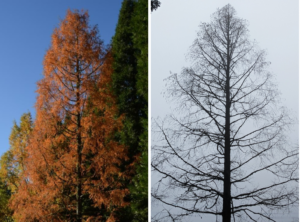
Whether or not that story is true, it’s only natural to experience growing pains when you’re reestablishing a living fossil that’s been absent from the landscape for millions of years.
The dawn redwood’s comeback even inspired Hoyt’s Musician in Residence Julian Saporiti to write a song about the tree’s long journey. The original dawn redwood is just off Bray Lane, but you’ll find several others along the Redwood Trail.
Raiders of the Lost Trees
Just across the street from the Visitor Center, a Cathaya argyrophylla grows along the Fir Trail. This is an exceedingly rare tree, with a total population estimated at 500 in the 1950’s.
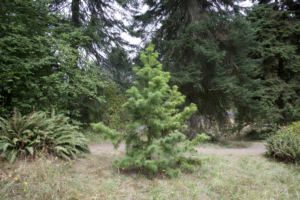
To protect this endangered species, the Chinese government restricted access, but scientific curiosity is insatiable. Smugglers managed to transport cuttings and seeds out of China in the 1960’s, which we can assume, eventually became the source of Hoyt’s Cathaya.
Despite its cloak and dagger origin and long journey, the tree is thriving. Knock on wood.
The importance of living fossils
It’s worth noting that Hoyt’s Cathaya specimens are of current scientific interest.
Arboretum Curator Martin Nicholson recently received a request for Cathaya pollen from a researcher at the University of Alaska Fairbanks. Measuring the pollen will help her to differentiate between similar types of pollen found in the fossil record.
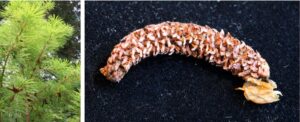
By hosting living fossils, arboreta and botanical gardens play an important role for new research into old things.
The Gink-golden Idol
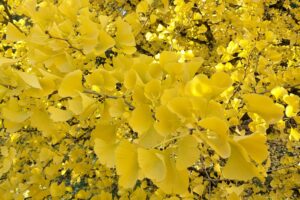
My personal favorite Chinese tree is the ginkgo. One Tuesday I was spreading mulch around the base of the ginkgos when the breeze sent their golden, fan-shaped leaves on a slow, glittering descent.
It remains the most beautiful moment I’ve had at the arboretum. It also may be my most lucky moment, since ginkgo leaves fall all at once.
Here today, gone tomorrow
This is how it works: as the days shorten and grow cooler, deciduous trees form a type of protective coating or scar tissue between leaf and tree. This coating weakens the leaf’s connection and protects the tree when the leaf falls.
Most trees form this barrier over weeks, gradually shedding leaves as they go. Gingkos form the barrier in a few hours after the first frost. Here today, gone tomorrow.
Watch the weather and visit just after the first frost to see the gingkos shed their golden treasure. Totally worth it.
A tree of spiritual and cultural importance
Fan-shaped leaves, like those of the ginkgo, appear in the fossil record as far back as 270 million years. The living species, Ginkgo biloba, was thought extinct until groves cultivated by Buddhist monks were found in remote Chinese mountains.
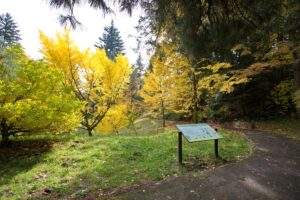
(Notice the theme of long-gone trees being rediscovered in spiritual places. Spend enough time around trees and it makes sense.)
Ginkgos are long-lived and hardy. In the right environment, they can live for thousands of years. They can tolerate significant stressors, such as city pollution and atomic bombs.
The arboretum nursery is currently growing a gingko “Peace Tree,” gifted from Japan. Peace Trees are the descendants of 55 trees that survived the atomic bombing of Hiroshima with their reproductive capacity intact. These trees serve as ambassadors of peace around the world.
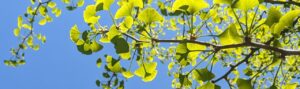
The largest collection of ginkgos is just off the Bristlecone Pine Trail. As part of the Bristlecone Pine Trail renovations, Hoyt’s Peace Tree will be planted in the new gathering area there.
Come Walk Among Them
The best way to get to know and appreciate these trees is to spend time with them. Fortunately, finding and visiting these Chinese trees has never been more convenient.
Hoyt Arboretum’s Plant Taxonomist and Herbarium Curator, Mandy Tu recently added a self-guided “Chinese Tree Tour – West Side” to the Plant Database; it visits 24 trees, including those in this story. Just click on the dropdown menu and select the tour. Come any day of the year to see these living fossils, beauties of bygone days, thriving in Hoyt’s living museum of trees.
And, as a Hoyt Arboretum volunteer, I’m excited to take advantage of one of the volunteer perks and attend Mandy’s in-person Volunteer Plant Walk and Talk in September focused entirely on Chinese Trees. I can’t wait to hear more thrilling stories about tree origins- Mandy’s Walk and Talks are one of the most amazing educational perks of volunteering here.
If you’re a fellow volunteer, come join me! Ask questions, wander, and hear the ancient and recent drama of Hoyt’s Chinese collection.
No fedora required- just comfortable shoes and a sense of adventure.
About the Author
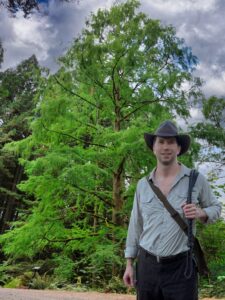 Spencer Miller is a fan of Indiana Jones and living fossils. Being able to combine the two is a real treat. You should treat yourself by visiting Hoyt Arboretum and exploring the rich history (and pre-history!) of its trees. See you at the living museum!