
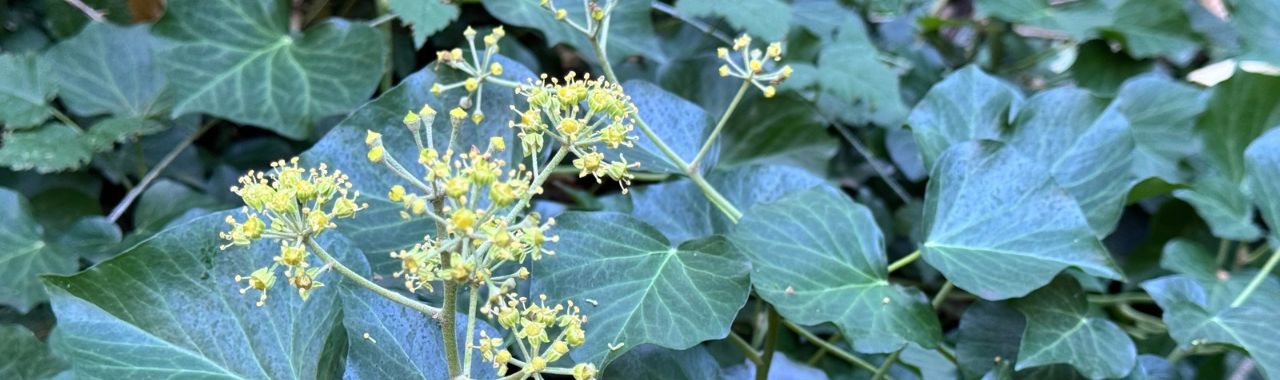
Portlanders love their trees. Our soaring Douglas firs, moss-draped bigleaf maples, and verdant ravines are more than just scenery—they are the city’s lungs, heritage, and identity. We pride ourselves on being a community that protects our wild spaces.
Yet beneath our world-renowned canopy lurks a silent, deceptive threat. It’s vibrant, glossy, and evergreen. To a casual visitor, it looks like harmless woodland charm.
To a Pacific Northwest forest, it is a slow-motion catastrophe: English ivy.
The Victorian Mistake
There is nothing inherently evil about Hedera helix. In its native European ecosystems, English ivy is an ecologically integrated groundcover kept in check by local pests, climate limits, and competing flora.
The trouble began in the late 19th century. Between 1875 and 1899 when well-meaning landscapers imported ivy to Portland gardens, praising its hardy nature, shade tolerance, and year-round greenery.
Turns out it was too good at its job.
A Slow-Motion Ecodisaster
Escaping manicured borders, the vine slipped into our damp, temperate forests. Here, in the mild Pacific Northwest, ivy found paradise: endless moisture, deep shade, rich soil, and perhaps most critically: zero natural predators. Freed from its Old World checks and balances, the ornamental garden darling transformed into an invasive super-spreader.
By 2010, the situation was so dire that the state of Oregon officially banned its sale, transport, and propagation, classifying it as a quarantined noxious weed. But by then, the green tide had already taken hold.
Anatomy of an Invasion
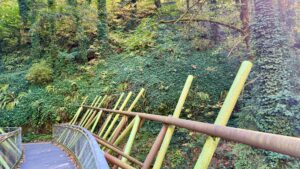
To walk through an untended Portland greenspace today is to witness an ecosystem under siege. The invasion happens in two brutal phases:
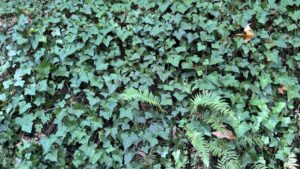
First, it carpets the ground. Spreading outward in thick, impenetrable mats, ivy smothers native trillium, sword ferns, and salal. Worse still, it blankets the forest floor so thoroughly that tree seeds cannot touch soil. It creates what ecologists call an “ivy desert”—a monoculture where no future generation of forest can take root.
Then, it climbs.
The Green Shroud
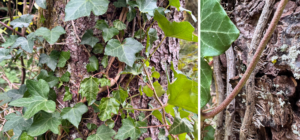
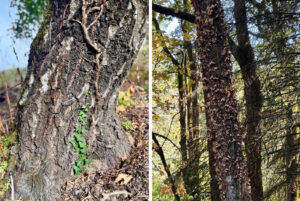
Using microscopic, glue-like rootlets, the vines scale the bark of mature trees, locking onto trunks in a vertical march toward the sun. As the vine matures into thick, woody ropes, it slowly constricts the trunk, damaging bark and opening wounds to rot and insect infestations.
Once in the upper branches, ivy unfurls a dense canopy of leaves that out-competes the host tree for sunlight, starving it of photosynthesis. During heavy Pacific Northwest winter storms, this massive blanket of vines acts like a soggy sail, catching wind and heavy snow until century-old trees snap under the unnatural weight.
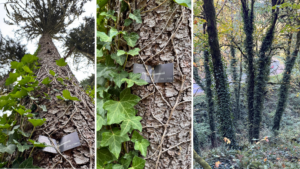
Winter storms aren’t the only concern. During prolonged dry spells, dead leaves and stems tangled in ivy can add to the forest’s fuel load. Where that dry material forms a continuous link between the ground and lower branches, it can act as a “fuel ladder”, giving flames a route from the forest floor toward the canopy.
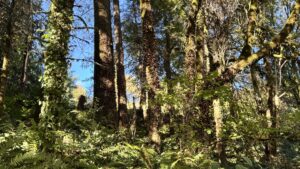
Left unchecked, a single vine doesn’t just kill one tree; it converts a vibrant multi-story forest into a graveyard of toppled trunks.
The Apex Predator: Us
Ecologists often lament that invasive species have no natural predators. But in Portland’s forests, English ivy does have a dedicated, relentless adversary: forest stewards.
Under ideal conditions, English ivy can creep up to 30 feet in a single season. But a single human being, equipped with hand pruners, work gloves, and determination, can clear 30 feet of ivy in about five minutes.
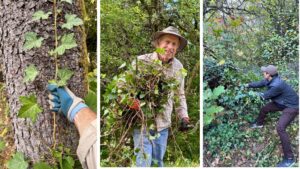
That is our superpower. Humans brought the problem here, but we are also the only force capable of reversing it.
When volunteers roll back ivy carpets and “save a tree” by cutting the ascending vines at shoulder and ankle height (a technique known as creating a “survival ring”), sunlight returns to the forest floor. Native seeds wake up. The tree breathes again. The transformation is immediate, tactile, and deeply satisfying.
No Ivy Day: A City Rolls Up Its Sleeves
Each October, hundreds of Portlanders pull on work gloves and answer the call of No Ivy Day, a citywide volunteer effort to reclaim our parks from English ivy.
The work happens one vine at a time. The impact reaches across the city.
In recent years, volunteer stewards have cleared acres of ivy and helped protect dozens of trees. Each patch reclaimed gives native plants room to grow and young trees a better chance to take root. Together, those patches become something bigger: a community investing in its forest’s future.
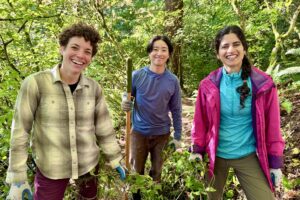
Mark your calendar for this year’s No Ivy Day on October 24th.
As in previous years, Hoyt Arboretum will join this citywide effort, hosting its own No Ivy Day event that coincides with its regular Saturday Crew.

One day won’t finish the job. But hundreds of determined neighbors can push back the green tide and build the momentum to keep going.
Join the Front Lines at Hoyt Arboretum
Saving our canopy doesn’t require a degree in forestry—just a willingness to get your hands dirty.
At Hoyt Arboretum, dedicated volunteer crews work year-round to roll back the green shroud and restore balance to our native woods. Whether you want a great weekend workout or a peaceful morning giving back to the land, there’s a crew waiting for you:
- Tuesday Crew: Meets every Tuesday morning, rain or shine, tackling high-priority restoration zones throughout the park.
- Saturday Crew: Meets bi-weekly on Saturday during the spring and fall seasons, offering a weekend option for families and working folks ready to yank some vines.
No experience is necessary; tools and training are provided. Come pull a vine, save a fir, and help ensure Portland stays green—the right kind of green—for generations to come.
Hoyt Arboretum Friends (HAF) is the nonprofit that organizes volunteer stewardship groups (and many other services) through their close partnership with Portland Parks & Recreation. You can support HAF’s mission of bringing people and trees together by becoming a member.
About the Author
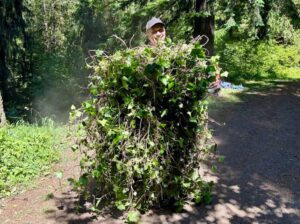
Spencer Miller has volunteered as a Tuesday Crew steward at Hoyt Arboretum, helping remove English ivy and make room for native plants. For him, freeing a mature tree from ivy feels like helping a gentle giant escape a trap. Join a stewardship crew and try it for yourself.