
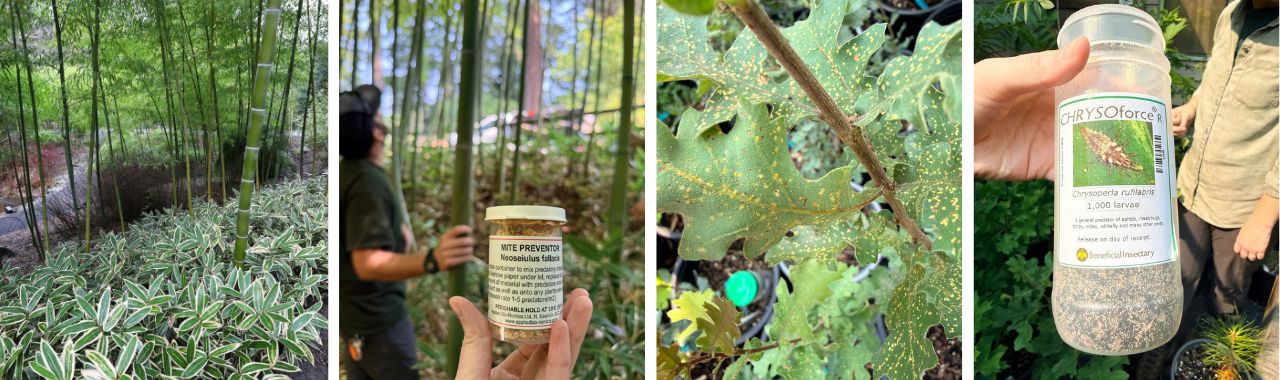
Last week, Hoyt Arboretum’s Curator, Martin Nicholson took a rare Friday off. Naturally, that was when a package containing live animals arrived at the Visitor Center. It had been hand-delivered to the front desk, labeled “PERISHABLE”.
Luckily, PP&R Horticulturist Vinny was around the corner to recognize the situation for what it was: not a surprise shipment of exotic pets, but a box of biocontrol insects (and arachnids) Martin had ordered to help deal with a mite problem in the bamboo forest.
And then Nursery & Planting Specialist Brett walked into the room, “Those are probably my lacewings too.” Pests have been eating oaks in the nursery, and the lacewings are part of the solution.
There was only one small problem: no one knew exactly what to do with them. To confirm the release instructions, we broke the cardinal rule and called Martin on his day off.
His soft New Zealand accent rang through the office on speakerphone, “Oh, I was worried they might show up today.” Followed by detailed instructions for where and how to release the tiny predators. Too excited to listen to what he was saying, I was focused on a feeling that’s become quite familiar. I’d stumbled onto a story.
Field Trip!
I got clearance from Vinny and Brett to observe in action what I’d totally missed from Martin on the phone. Vinny planned to do the bamboo release after lunch.
I went into another meeting. When I came back out, Vinny was nowhere to be found, so I tracked him and Park Tech Ian down in the bamboo, where they had already gotten to work. They were using a throw line to get a string up high into the bamboo.
“You found us,” Vinny said when he spotted me. “We were feeling a little camera shy.” Ian laughed.
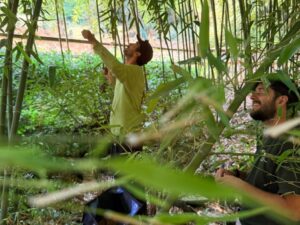
I tried to remain unobtrusive, while also making the occasional joke about throw line mishaps, which I began to understand was exactly the wrong strategy if your goal is to make two people feel less observed.
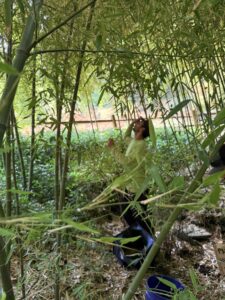
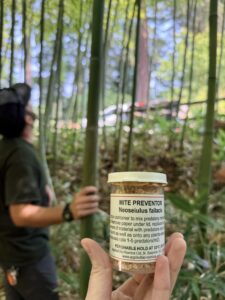
Vinny eventually got the line where he wanted it, tied a piece of string to the end and looped it around the tops of the bamboo. Then he pulled a tiny pill-bottle-looking container from a bag and handed it to me.
 .
. 
Fighting Mites with Mites
The container held Neoseiulus fallacis, a commercially available predatory mite used in biological control. These tiny arachnids are predators of pest mites, including spider mites, and they can be particularly useful for maintaining low to moderate pest populations.
The timing mattered because the mites had arrived as eggs, on ice. Once they warmed up, they would begin hatching and once that happened, the feast would begin. Since we wanted the main course to be spider mites, and not their own kin, we were eager to let them out.
Vinny tied the little container to the string and began slowly pulling it upward. Watching someone send a container of predators into a tree is not exactly dramatic television. There were no explosions. No chase scenes. No tiny helmets. And that’s often what IPM looks like.
Integrated Pest Management in Practice
IPM is not simply “don’t use chemicals.” It is a broader approach to pest management that starts with monitoring and identifying the problem, deciding how much damage is actually acceptable, and then choosing the most appropriate combination of tools to keep the pest population below that threshold.
Biological control, or using natural enemies such as predators, parasitoids, or pathogens is one of those tools.
Sometimes that means conserving beneficial organisms that are already present. Sometimes, as with our Neoseiulus it means augmenting those populations by bringing in commercially reared biocontrol agents.
The idea is not necessarily to eliminate every pest. In a living collection, that would often be unrealistic; the goal is to keep pests at levels where they are not causing unacceptable damage.
The more tools you have available, the more options you have for responding to a problem. Which brings us back to the nursery.
Oak Pests in the Nursery
A little while after I returned to my desk, Brett came over and tapped me on the shoulder. She had another biocontrol story to show me.
Brett is particularly good about pulling me into the cool, weird things she is doing at the Arboretum, which is ideal for me because “cool, weird things” is more or less my favorite category of material.
The need for pest management in the nursery was immediately obvious. Inside the hoop house, many of the young oak trees had significant damage to their leaves.
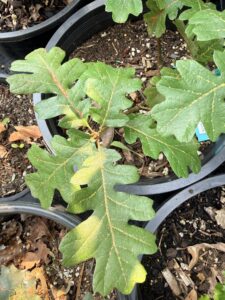
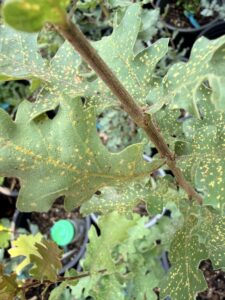
Enter the Lacewings
Brett pulled out a container that looked remarkably like a parmesan cheese shaker. Inside were eggs of Chrysoperla rufilabris, a species of green lacewing. Adult lacewings are delicate, beautiful insects. Their larvae are another story.
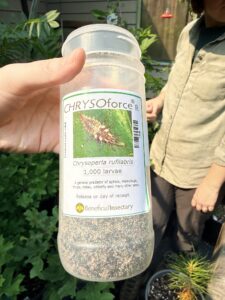
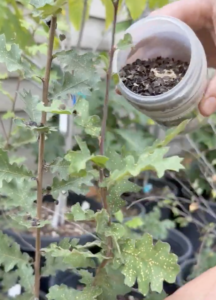
Lacewing larvae are voracious predators, feeding on soft-bodied pests such as aphids, thrips, mealybugs, scale insects, and other small prey. They are sometimes called “aphid lions” because of their hunting prowess. The shaker contained the eggs mixed with chaff to help distribute them.
We opened it up. A few had already hatched.
There they were: tiny little lacewing larvae crawling around, apparently ready to get to work.
Brett shook the eggs and chaff out onto the branches of the oak seedlings, distributing them among the plants.
Another goodie from Martin’s shipment: lures that look like big tea bags to hang in the hoop house. “Smell this,” Brett said presenting the lure to my nose.
My eyes widened, “Root beer!”
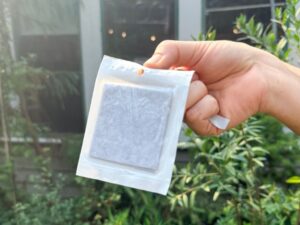
The lures encourage adult lacewings to stick around the area. They generally feed on nectar, pollen, and aphid honeydew, while their larvae do the heavy lifting when it comes to predation. Supporting adult lacewings can therefore help encourage continued egg-laying and future generations of beneficial insects.
One Week Later
The following week I was headed back into the office through the maintenance yard and found Martin and Brett in the hoop house, looking over the oaks. The damage to the oak leaves was still there. Unfortunately, biocontrol does not come with an undo button. But that wasn’t really the goal.
The hope was that reducing the pest population would give the trees a chance to recover and continue growing without sustained pressure. As we looked over the plants, Martin spotted an egg mass on the underside of a leaf.
Was it from a lacewing? We hoped so.
Pest management in an arboretum is rarely as simple as “find bug, kill bug.” The collections are alive. They are interconnected. They include mature trees and seedlings, plants from different climates, greenhouse specimens, wild habitat, and an entire community of insects and other organisms that call the Arboretum home.
That means caring for the collections sometimes requires a little detective work and a lot of creativity. To me, the most interesting part is simply watching the people who care for these plants figure it out.
About the Author
 Rebekah Golden has the Communications Specialist for Hoyt Arboretum Friends (HAF) since 2022. Before her work with HAF, Rebekah earned a degree in Ecology and Evolutionary Biology from the University of Arizona. She moved to Portland where she worked with partners to launch a business that brought increased awareness to local bees and pollinators.