
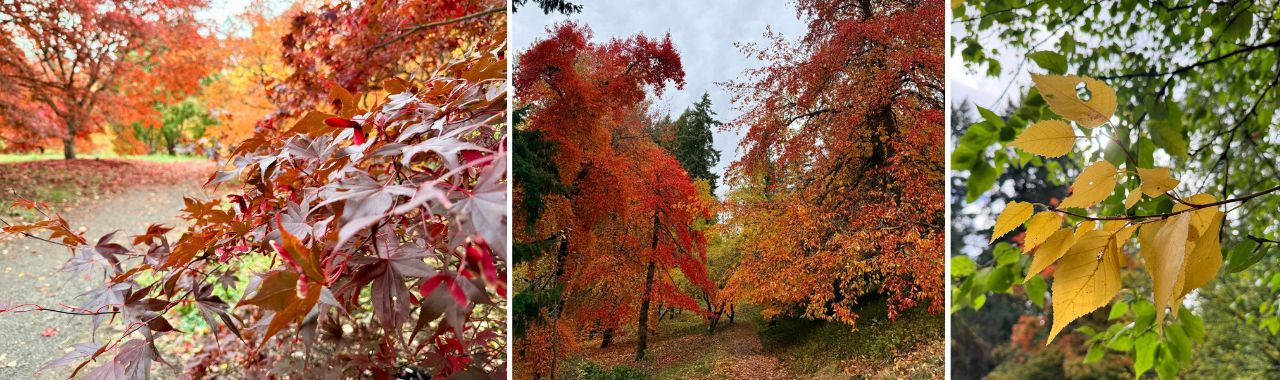
As we pack up our beach towels and sunscreen for 2026 and start unboxing the sweaters from the back of the closet, Hoyt Arboretum is undergoing its own seasonal changeover. The green canopy that carried us through summer is beginning to give way to a slow-burning show of gold, crimson, and copper that transforms the arboretum into one of Portland’s best leaf-peeping destinations.
Autumn is magic at the Arboretum, and with a little help from HAF’s comms specialist Rebekah, I’ve identified three trees at Hoyt Arboretum worth chasing this fall.
Japanese Maple
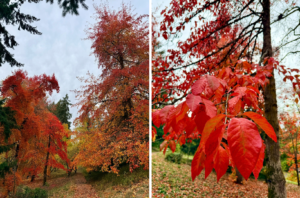
It is impossible to talk about fall at Hoyt without starting here. Maple Trail is home to a nationally accredited collection of more than 90 maple species, subspecies, and cultivars making it the epicenter of fall colour at the Arboretum.
Of the most dazzling, Hoyt Arboretum’s Maple Collection includes 10 cultivars of Japanese maples (Acer palmatum) with leaves that shift through fiery reds, oranges, and deep burgundies as the weeks go on.
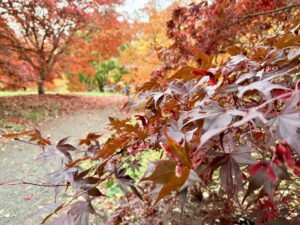
There is one specimen of Acer palmatum ‘Ornatum’ or the “red laceleaf Japanese maple” of particular note along Maple Trail, and is one of the most photographed trees in the park. If you only have time for one stop, make it this one.
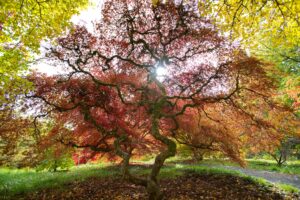
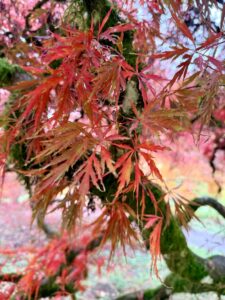
Get close to the branches along the trail, or crawl underneath to fully appreciate the spectacle and recognize the following leaf features:
- Leaf forms are deeply and finely dissected forming narrow, lace-like ferny lobes
- Leaves are palmate, resembling an open hand with 7–9 pointed lobes
- Leaf size ranges from 5–10 cm (2-4 inches)
- Margins are deeply serrated
Wondering how Japanese maples came to the Pacific Northwest? They were first brought into North America during the mid‑1800s, following the Perry Expedition to Japan in 1854. They became established in the Pacific Northwest through a combination of 19th‑century plant introductions and the region’s favourable climate.
IUCN Red List Status: Least Concern
Black Tupelo
If you’re already on the Maple Trail chasing the Japanese maples, keep walking — the black tupelos (Nyssa sylvatica) waiting along the stretch of Maple that crosses the curved Kingston Blvd between Overlook Trail and the start of Wildwood Trail near the Vietnam Veterans of Oregon Memorial. It’s worth the extra steps (which include a long staircase at one end if you are so inclined).
Black tupelos exhibit the following leaf features:
- 8-15 cm (3-6) inches long leaves
- Elliptical to ovate, sometimes oblong, with a smooth outline
- Glossy dark green on top, paler underneath in summer
In summer, the foliage is a glossy dark green, but in autumn it transforms into one of the most dazzling displays of colour among North American trees, ranging from scarlet and orange to deep purple. Its understated summer appearance makes the fall transformation even more striking along the trail.
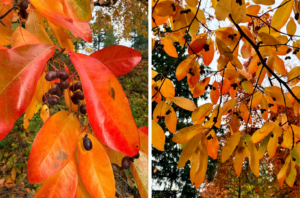
IUCN Red List Status: Least Concern
Paper Birch
Maple Trail gets a lot of attention, this time of year (and rightfully so), but the season’s beautiful displays are not contained to that 0.5 mile stretch. On the other side of the Arboretum, the geographic collections on Bristlecone Pine Trail include some of my favourite fall foliage trees. The paved section of the trail features a ginkgo grove near the Stone Circle, a few brilliant sugar maples, and in between, some lovely paper birch trees (Betula papyifera) that are worth pausing for as their dark green leaves turn to clear yellow.
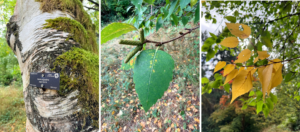
Look for the following leaf features:
- Ovate to triangular shaped leaves, with a pointed tip
- 5-10 cm (2-4 inches) long, doubly serrated (toothed) edges
- Thin, papery, and smooth, matching the tree’s delicate bark
IUCN Red List Status: Least Concern
Until Next Season
Fall colour at Hoyt Arboretum can move quickly, and factors like rainfall and temperature shift the timeline every year, so plan for a bit of trial and error. As a general rule, expect the first colour in late September, a steady build through October, and the most vibrant stretch arriving by early-to-mid November. However you plan your visit, layer up, grab a trail map at the Visitor Center, and let the Arboretum’s 12 miles of trails lead you to whichever tree stops you in your tracks this fall.
Thanks again to Rebekah for the tree recommendations — this fall edition wouldn’t have the same colour without her.
See you again next season!
About the Author
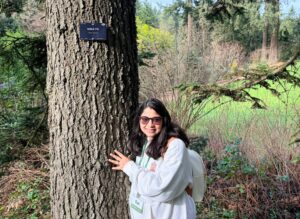 Sailatha Theagaraj (she/ her/hers) is a recent volunteer at Hoyt Arboretum, having moved to the region not long ago. Sai holds a Master’s degree in Environmental Science and Technology and brings global experience in environmental sustainability, sustainability consulting, green building certifications, and circular economy work. She has led sustainability initiatives for major infrastructure projects and has trained many professionals in environmental sustainability practices. Her favourite places in the Arboretum are the Conifer Collection and enjoying a quiet moment at the Stevens Pavilion, listening to the surrounding sounds of nature. She is passionate about conservation, sustainability education, and environmental awareness.