
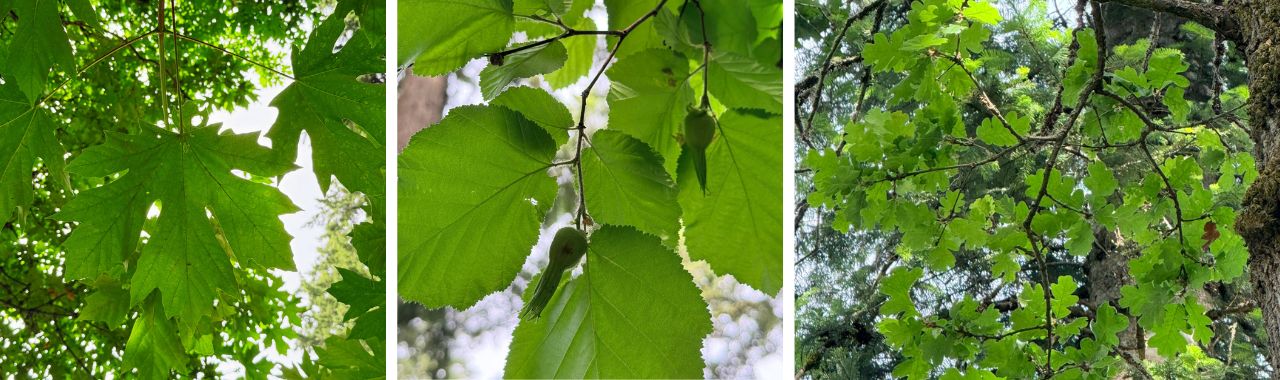
Summer, especially for children, is a season of making new friends — and at Hoyt, those friends can be tree friends too. It’s the perfect time to slow down, look closely, and learn to recognize your new green companions by the shapes and textures of their leaves.
Focusing tree identification around leaf morphology helps young explorers build familiarity the same way they would with any new friend: noticing what makes each one unique. Here are some leaf‑morphology tips to help you and your young adventurers get to know the native trees that brighten our summer trails.
Welcome to my Summer Guide
If you’re planning a visit to this remarkable living museum of trees, here is my collection of favourite summer trees native to the Pacific Northwest to watch for during your walk along the trails — and how to recognize them based on their leaf shapes.
These native trees can be found in numerous places around the park, but I’ve chosen 3 specific trees you can visit to learn from. The trees are listed in number order corresponding to the numbers on the map markers.

1. Big Leaf Maple
Located on Overlook Trail, parallel to Beech Trail and just above the parking lot, stands a particularly huge and ancient Bigleaf Maple—estimated to be nearly 200 years old.
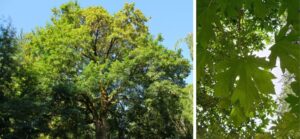
The Bigleaf Maple (Acer macrophyllum), a beloved Pacific Northwest native, is known for having the largest leaves of any maple species in the world. These fast‑growing deciduous trees are easy to recognize by their broad, palm‑shaped leaves—often compared to an open hand—that captivate visitors with their bold form and the warm golden tones they display in autumn. If you’re learning to identify trees by their leaves, this is one of the easiest species to spot thanks to its distinctive leaf morphology.
Leaf features of the Bigleaf Maple include:
- Palmately shaped leaves with 5 deeply incised lobes, measuring as big as your head (6 to 12 inches wide).
- Smooth, untoothed margins between the lobes
- Glossy dark green upper surface with a paler underside
The Bigleaf Maple plays a vital role in local ecosystems and Indigenous cultures. Its sap can be used to make maple syrup, its wood is valued for furniture and carving, and its leaves and branches support a wide range of wildlife. The tree’s broad canopy and rich leaf litter also help create moist, shaded understories that nurture ferns, mosses, and forest floor species. There is also a really gorgeous big bigleaf maple right by Stevens Pavilion next to the stairs that lead to Fir Trail.
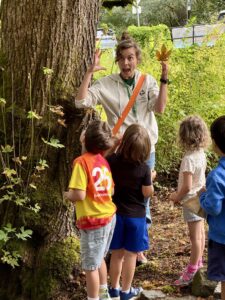
Kids especially love this tree because the leaves are so huge. On field trips to the Arboretum, the staff often run a friendly contest among school kids to see who can find the biggest leaf. It is a simple activity you can try during your own visit, and a fun way to help young explorers make “tree friends” and start noticing leaf shapes as part of learning to identify trees through leaf morphology.
IUCN Red List Status: Least Concern
2. Beaked Hazelnut
If you spot a shrub with a distinctive beak‑like husk enclosing edible hazelnuts in late summer, you are likely looking at the Beaked Hazelnut (Corylus cornuta). The unique shape of its nuts makes it an outstanding summer species to watch for along the trails. This shrub appears all over the Arboretum, but if you want a reliable place to see one up close, there is one behind Stevens Pavilion, near the stairs that lead down to the Bamboo Forest.
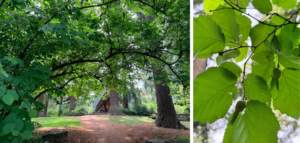
The nuts themselves can be tricky to find — local squirrels adore them and often snap them up long before visitors arrive. It’s a fun reminder that many of the trees and shrubs we admire are also important food sources for wildlife, and noticing these clues can help young explorers start paying attention to tree identification features in the landscape.
Leaf features of the Beaked Hazelnut:
- Oval to ovate leaves with a flat or heart‑shaped base
- Bright green foliage, 2 to 5 inches long
- Doubly serrated (toothed) margins with a fuzzy‑textured underside (touch them- they’re very soft!)
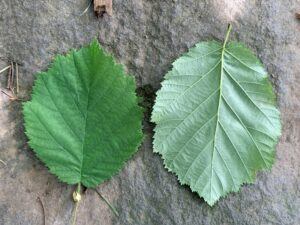
In autumn, the foliage turns a bright yellow, adding a warm colour to the understory.
IUCN Red List Status: Least Concern
3. Oregon White Oak
As the name suggests, the Oregon White Oak (Quercus garryana)—the predominant oak species of the Willamette Valley—is native to the Pacific Northwest. At Hoyt Arboretum, the most stately and prominent of the Oregon White Oaks is located on the upper Fir Trail.
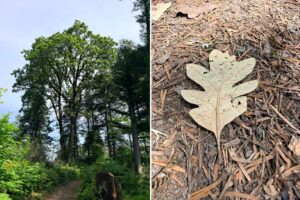
Look for these leaf features on the Oregon White Oak:
- Oblong leaves, 5–15 cm long, with rounded lobes
- Dark green foliage that is deciduous (leaves drop in fall)
- A leathery texture on the underside of the leaf
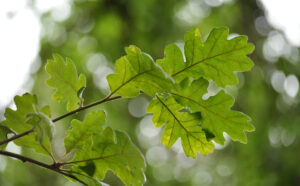
The acorns of the Oregon White Oak are a critical food source for more than 200 species of insects, birds, and mammals in the region. These oaks are also more fire‑resistant than many competing conifers, allowing them to persist in dry, open habitats where other species struggle.
IUCN Red List Status: Least Concern globally but that designation does not reflects the status in the Pacific Northwest.
NOTE: Even though this tree is not considered endangered around the world, things look a little different here in the Pacific Northwest. Long ago, gentle, low‑burning fires moved through oak savannahs every few years. These fires didn’t hurt the big oaks, in fact, they helped them by keeping the spaces around them open and sunny.
But today, most fires are put out right away, and the cultural burns once practiced by Indigenous communities are no longer common. Without those helpful fires, fast‑growing trees like Douglas‑fir move in and crowd out the oaks. So even though the species is doing fine globally, its habitat is disappearing here in our region because the natural process that once protected it (frequent fire) has been taken away.
Until the Next Season’s Walk
This Summer Edition highlights a few seasonal favourites native to the Pacific Northwest—trees that stand out in their summer form, invite closer observation, and help us appreciate the richness of our regional ecosystems. As summer unfolds across the Arboretum, each trail offers its own quiet discoveries—sunlit canopies, textured leaves, and the subtle movements of wildlife that thrive among these trees. Spending time with these species reminds us how much there is to learn simply by slowing down and paying attention to something as simple as a leaf.
I hope this guide encourages you to pause, look closely, and enjoy the small wonders that make each visit to Hoyt Arboretum unique. Until the next season’s walk, may these trees continue to inspire curiosity, care, and a deeper appreciation for the living landscape around us.
See you again this season!
About the Author
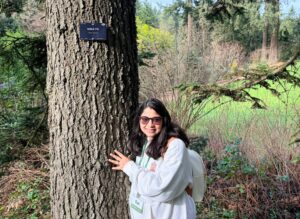 Sailatha Theagaraj (she/ her/hers) is a recent volunteer at Hoyt Arboretum, having moved to the region not long ago. Sai holds a Master’s degree in Environmental Science and Technology and brings global experience in environmental sustainability, sustainability consulting, green building certifications, and circular economy work. She has led sustainability initiatives for major infrastructure projects and has trained many professionals in environmental sustainability practices. Her favourite places in the Arboretum are the Conifer Collection and enjoying a quiet moment at the Stevens Pavilion, listening to the surrounding sounds of nature. She is passionate about conservation, sustainability education, and environmental awareness.