
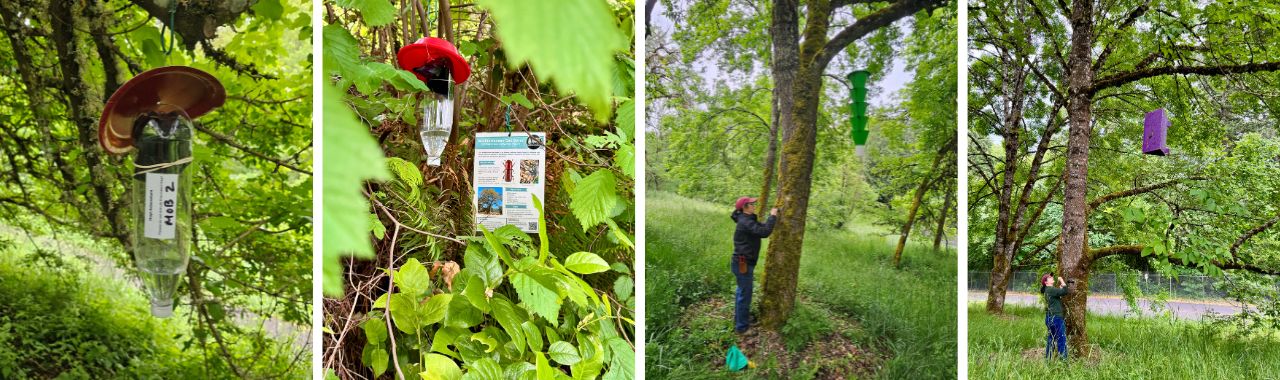
If you’ve strolled through Hoyt Arboretum lately, you might have spotted something odd hanging from a few of the trees: clusters of green buckets stacked like a tower, or strange purple boxes suspended from branches.
These aren’t art installations. They’re traps, quietly watching for an unwelcome guest.
Portland Parks & Recreation, working with universities and state partners, uses these traps to detect invasive pests before they can spread.
A New Threat
In past years the Arboretum has kept watch for emerald ash borer, Japanese beetle, and spotted lanternfly. This year, a tiny new threat joined the list: the Mediterranean oak borer, or MOB.
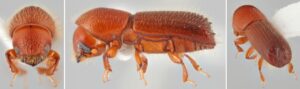
At just 3.0 – 3.2 millimeters long, the MOB is easy to miss…until it’s too late. “By the time you detect the MOB, it’s usually been established in the tree for years,” says Mandy Tu, the Arboretum’s Plant Taxonomist and Herbarium Curator.
Fungal Vectors
The first signs are almost invisible: pinprick holes in the bark and a dusting of fine sawdust and waste called “frass.” Inside the tree, the beetles carve winding tunnels known as “galleries.”
The real damage comes from a fungus the beetles carry with them. As the fungus spreads through those tunnels, it blocks the tree’s ability to move water and nutrients.
Over time the canopy thins, branches die back, and the oak slowly declines. By the time the damage is obvious, the infestation is often years old.
Clever Hacks and Coffee Filters
That’s why early detection matters so much. Every week, a small team of community scientists checks the traps and scans the trees for trouble.
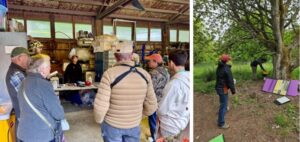
One of those volunteers, Chad Kirkpatrick, even found a simple fix: mixing water with the isopropyl alcohol in the traps so it evaporates more slowly.

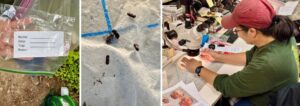
The beetles, drawn to the ethanol lure, fall in and drown. Volunteers then strain the liquid through coffee filters, bag whatever they catch, and bring it to Mandy for inspection under a microscope.
“Probably Inevitable”
So far, the Mediterranean oak borer hasn’t shown up at Hoyt Arboretum, but it has already been found elsewhere in the Portland area. Without natural predators here, its spread feels, in Mandy’s words, “probably inevitable.”
Still, she isn’t discouraged. “These are early days,” she says. “We’ll keep watching and see what happens.” Some oaks may prove resistant on their own, and targeted treatments may exist for high-value trees, though they’re costly .
For now, the work is about staying alert, and taking comfort in the fact that when the beetle does arrive, the Arboretum will know.

About the Author
Spencer Miller grew up in North Carolina and is well-acquainted with the harmful impacts of the Japanese beetle and kudzu. He thinks it’s worth the extra effort to detect and slow the spread of invasive species.