
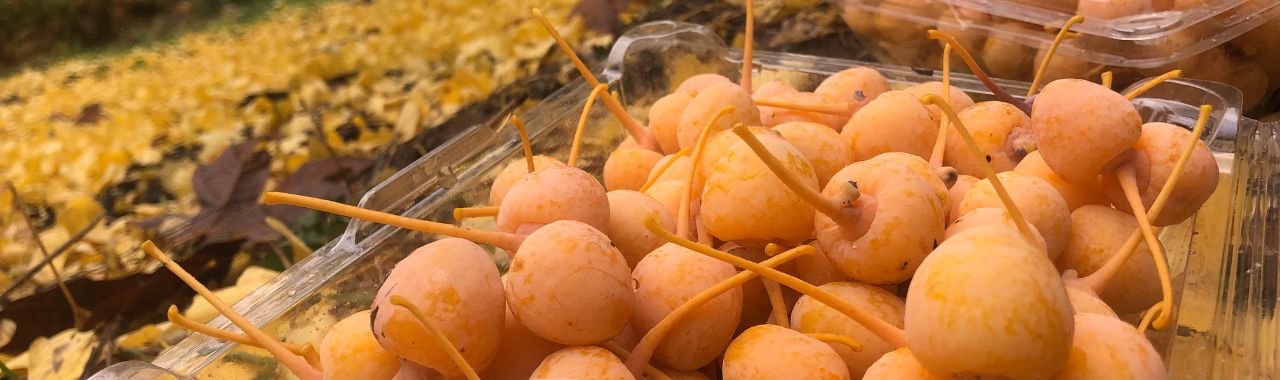
Yesterday, the Hoyt Arboretum team welcomed some friends from the Portland Fruit Tree Project (PFTP) for a special fall harvest: collecting ginkgo fruits from one of Hoyt’s most remarkable trees. Together, the team gathered 77 pounds of fruit that will be processed and donated to the Asian Food Pantry at the Center for Positive Aging.
Community Partnerships Bring People and Trees Together
PFTP is a grassroots nonprofit that organizes community harvests from fruit trees across Portland. By harvesting fruit from private yards and public spaces, they prevent food waste, expand access to fresh produce, and strengthen community relationships. Their recent collaboration with the Asian Food Pantry focuses on collecting culturally significant fruits—such as persimmons, goumi berries, and for the first time this year, ginkgo nuts.
Harvesting Ginkgo ‘Fruits’
PFTP approached Hoyt Arboretum Friends about harvesting ginkgo ‘fruits’ [1] from Hoyt Arboretum’s collection. While foraging is not permitted in Portland Parks—to protect plant collections and to ensure equitable access among other reasons—we are committed to working with community partners like these to connect people to the ecological and cultural stories behind the trees. Through this partnership we were also able to ensure that the harvest was conducted safely and sustainably.
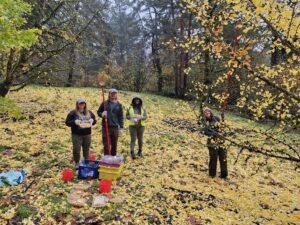
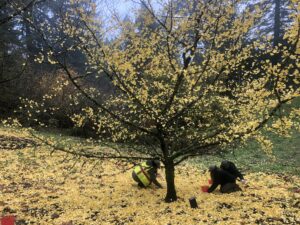
Hoyt’s Nursery Specialist Brett Rousseau shared a little bit about the process, “we gently shook the branches of the tree sending small golden fruits cascading to the ground and among a sea of yellow leaves. Then we picked through everything by hand.” Brett is also a visual artist with a distinct appreciation for the beauty of this tree.
Male vs. Female Ginkgos
Many know ginkgos as fall favorites at Hoyt Arboretum, their bright yellow, fan-shaped leaves now forming golden carpets over the hillside on Bristlecone Pine Trail. Fewer people realize that ginkgo trees are dioecious– with separate male and female forms. It is the female trees that produce the famously pungent ‘fruit’ that holds the edible nut. As such, all ginkgos at Hoyt Arboretum were males at the time of planting.
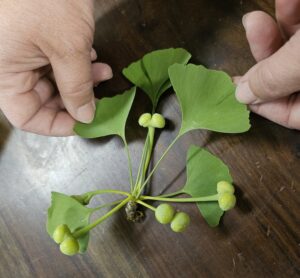
In a twist of botanical surprise, the Ginkgo biloba ‘Autumn Gold’ in the collection began producing female fruit some time ago, and for the first time this year, Plant Taxonomist and Herbarium Curator, Mandy Tu collected female developing ovules from this tree to preserve in the Arboretum’s Herbarium.
This is a natural phenomenon that occurs across several species of plants.
More on that here.
Now, just months later, those fruits have helped provide food for the community.
Processing Ginkgo Nuts
The Autumn gold ginkgo turned out to be a prolific producer, and along with some fruits from another newly female gingko in the grove the team gathered 77 lbs of fruit! Along with yields from other collections around town, the PFTP will process the fruits before bringing them to the Asian Food Pantry.
“I don’t know if they expected to get so much!” Hoyt’s Community Engagement Coordinator Rowan shared in the day’s retrospective, “they’re doing all the processing so the offices at CFPA don’t stink up! I think their plan is to do it outside.”
The process for preparing ginkgo nuts is an involved one, requiring protective gloves to remove the flesh, and boiling or roasting the seed for safe consumption.
Driscoll’s Ginkgo Nuts
“I loved seeing all the ginkgo fruits lined up in repurposed Driscoll’s strawberry boxes,” Brett reflected, “it helped me imagine a future where culturally significant foods like ginkgo nuts are as easy to find at the grocery store as any other local produce.”
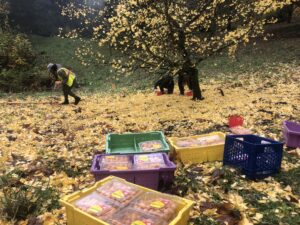
That image captures the spirit of the day: neighbors and partners, hands sifting through the leaves, all working together to create a more inclusive and connected urban forest.
Footnote
Since ginkgos are gymnosperms, they don’t produce true fruits–ie: the seeds do not form inside of an ovary. The fleshy, apricot-like structure that drops from female ginkgo trees is a seed with a fleshy outer layer called a sarcotesta–well known for smelling like vomit due to butyric acid. Ginkgos are ancient trees–living fossils–and the scent of the ‘fruit’ is speculated as an attractant to some unknown extinct animal.
Partnerships like this help Hoyt Arboretum bring people and trees together in meaningful ways.
Support our community programs and help us continue this work by making a gift today: hoytarboretum.org/donate