
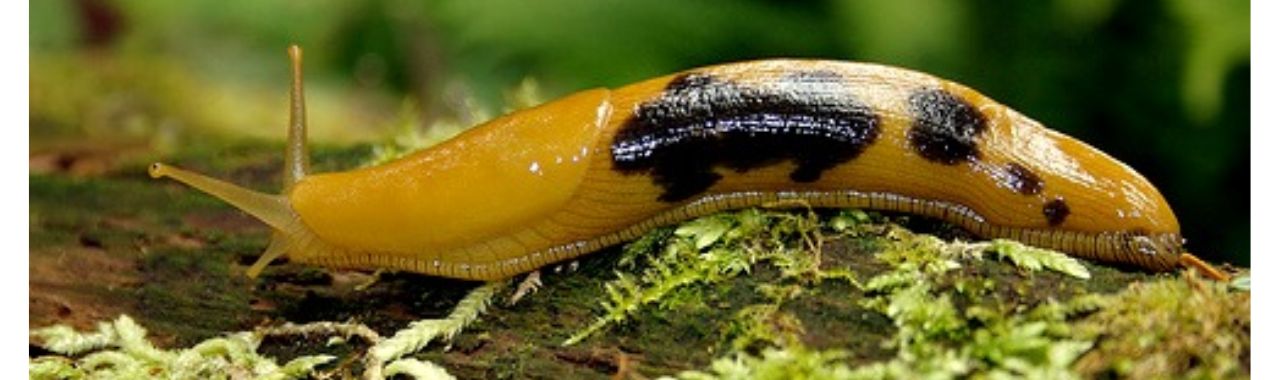
Hi, I am a Pacific Banana Slug. Scientists call me Ariolimax columbianus and say that I am the second largest slug in the world, growing to nearly 10 inches long. I am native to the Pacific Northwest region and love dark, cool and wet forest floors like the densely forested portions of Hoyt Arboretum.
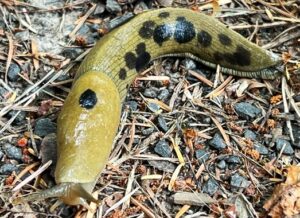 I like to eat decaying leaves and other plant material on the ground, including stopping from time-to-time to coil around to eat the leaf debris and pine needles that gather at my tail. By eating leaf litter and other organic matter like fungi and animal droppings, I help to break down and recycle plant materials, spread seeds and spores, and play a vital role in the forest by helping to maintain a healthy forest ecosystem.
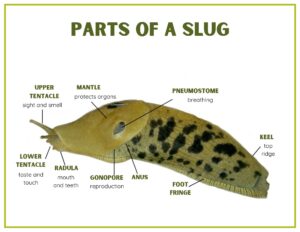
I have two sets of tentacles on my head, the top and longer two tentacles are for sensing light, while the lower and shorter two are for smell. I retract my sensitive tentacles if you get too close (to protect them), and will shrink to a tiny fraction of my full length if I sense danger. During the hottest part of the day I take shelter under leaves and logs, and on extra hot days I will hibernate to protect myself from the heat.
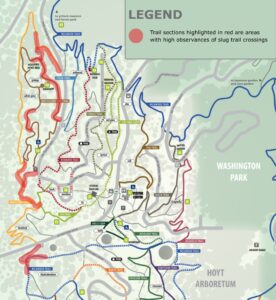
On rainy days or cool summer mornings you are almost certain to see me crossing trails within Hoyt’s forested sections, especially those near one of the creeks. I am one of the slowest species on the planet, so trail crossings are extra dangerous for me. It can take a long time when moving at 6.5 inches per minute. Some trails can take me 15 minutes to cross! So please watch out for me while walking within this forested area.
These are some of my favorite spots.
If you see me on the trail, then you can help me safely cross the trail by hanging out with me while I cross. You can also gently pick me up using fallen leaves, but please make sure not to touch me with your bare hands as I breathe through my skin and human hand oils can harm me.
As an iconic symbol of the Pacific Northwest Forests, I can be an important reminder that small, slow, soft, and vulnerable does not mean unvalued, as I am a cherished contributor to a healthy forest ecosystem.
The Joy of Caring for Nature
Over the decades I can’t recall a PNW hike that didn’t include seeing a banana slug on the trails, and unfortunately, also seeing a banana slug that had been stepped on. When hiking in the forests I would typically pay banana slugs just enough attention to avoid stepping on them. However, that changed a few years ago when I decided to hangout as long as it took for a banana slug to cross the trail at its own pace.
Volunteering at Hoyt has allowed me to share my appreciation for banana slugs and their native home within pacific northwest forests. Compared to squirrels, rabbits, deer, barred owls, and many of the other critters that a visitor might encounter at Hoyt, banana slugs only require about a foot of space to go about their “business” with undisturbed natural behaviors, which means slowly moving across a trail so that visitors have plenty of time to get up close, learn about them, and become more connected with their drastically different world.
After one of these banana slug encounters, I’ve found that people are no longer grossed out by banana slugs, and have instead become invested in their well-being and feel good about having helped them safely cross a trail. I’ve also found that joy comes from caring for our world, so what an amazing gift for one of the slowest and slimiest of animals to give us fast moving and most-often disconnected creatures!
About the Author
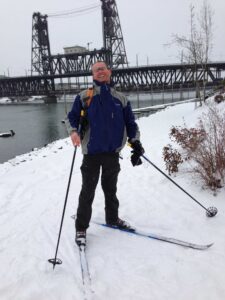 Chad Kirkpatrick (he, him, his) has been volunteering at Hoyt Arboretum since 2025 but has been enjoying the park as his local retreat for decades. He has joined the volunteer community as a Trail Rover, Community Scientist, and Hike Leader. His favorite spot in the Arboretum is the meadow above the Holly Loop before mowing in the spring,when the tall grasses reach human height and sway in the wind. He also loves the Beech Trail in fall when the colors “light up like a cathedral”. Chad has worked in sustainability, architecture, and product design and manufacturing for 3 decades, all while hiking all over the PNW in his personal time.