
One of my favorite things about Hoyt Arboretum is the unexpected adventures you encounter on every trail. Each hike, class, or volunteer activity offers a delightful detour from the ordinary. There’s always something wonderful waiting to be discovered.
The Call to Adventure
Nursery and Planting Specialist, Brett Rousseau, recently asked if I’d like to help out with a special project on the Bristlecone Pine Trail (BPT).
Absolutely. I know a call to adventure when I hear one.
The Bristlecone Pine Trail Project — Helping People, Helping Trees
We met up with Ruth Williams, a longtime Arboretum educator and a consulting arborist on the BPT Project. Ruth was there to locate and assess the health of certain trees along the BPT.
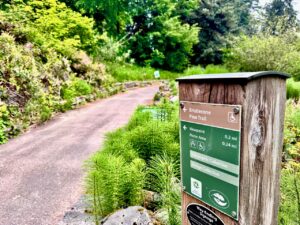
To provide context, the BPT is notable for having paved trails and a parking lot at the trailhead. Built in 1986, it was the first major Portland Parks & Rec trail designed to accommodate American Disabilities Act (ADA) accessibility.
The “Braille Trail”
Later this summer, the BPT will be demolished and reconstructed to vastly improve ADA access. More on the Bristlecone Pine Trail ADA Accessibility Improvements Project here.
The paved trails will be improved, expanded, and extended. What’s more, new signage will include Braille text, and tactile features so the “Braille Trail” will improve interpretation among the geographic tree collections for more visitors than ever.
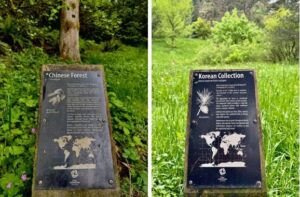
Current geographic collection signage:
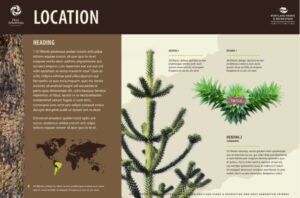
A sneak peek at future geographic collection signage:
The downside of this renovation project is that heavy machinery will have to operate near trailside trees.
Despite that, the Arboretum expects a 99 percent survival rate for trees adjacent to the construction zone. To prepare, staff and consultants are assessing current tree health in the impacted area.
Open Wide and Say “Ahhh” (boretum)
With a map in one hand and a retractable measuring tape in the other, Ruth led us on a field trip to give the trees their checkups.
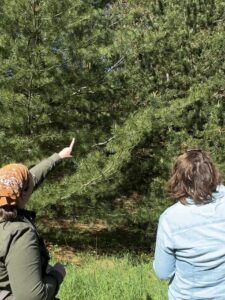
The assessment was two parts. First, we measured the trunk diameter at breast height, or “DBH”, as they called it. Then Ruth visually assessed tree health as either Excellent, Good, Fair, Poor, or Dead, while noting any outstanding features.
The DBH lets arborists estimate the extent of a tree’s critical roots. For example, a tree with a DBH of 12 inches will generally have a root network approximately 12 feet in radius. This helps create exclusion zones so the heavy machinery won’t crush tree roots.
The Perfect Pine
As Brett and I zigged and zagged across the trail, searching for ID tags that matched Ruth’s list, she explained that very few trees receive an Excellent rating. Even small imperfections are enough to disqualify one.
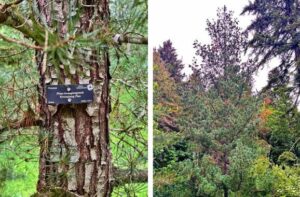
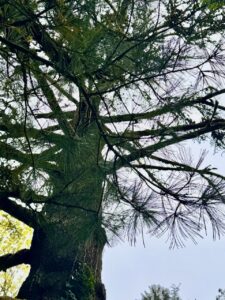
Most trees fell into the Good category, but only one paragon of a pine received the elusive top rating. Fittingly, the Excellent tree was also the last on the list. Check out this perfect Kwangtung Pine (Pinus kwangtungensis).
“Not Just Dead, but Dead-Dead”
As we strolled back to the trailhead I had the exciting opportunity to listen in as two arborists talked trees.
Ruth explained that, much like the Excellent rating, it’s rare for a standing tree to receive a Dead rating. She explained that it must be truly dead, not just mostly dead.
A Snag on the Trail
I pointed out a snag we were approaching as a possible candidate. Snags are terminally damaged trees that remain standing.
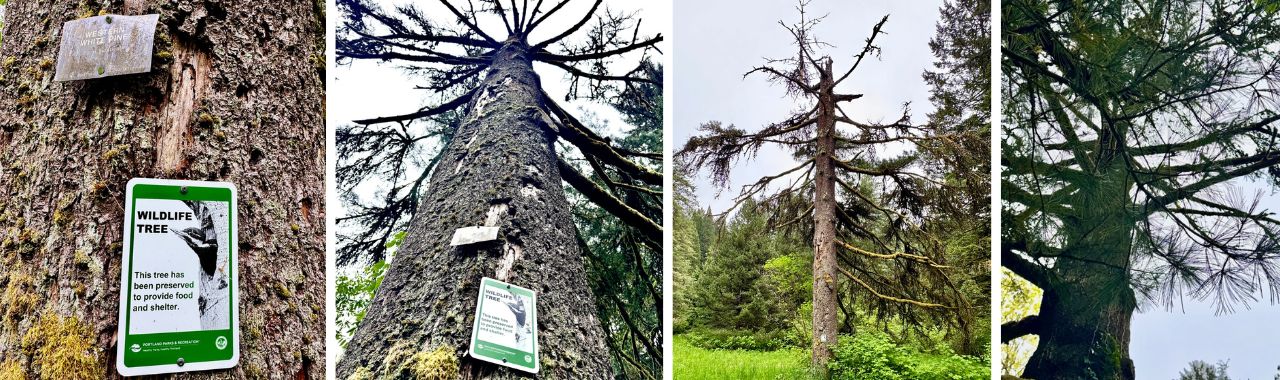
This particular snag looks like a cannon crew used it for target practice. The top of the tree is broken off and the trunk is riddled with holes, some large enough to fit a fist inside.
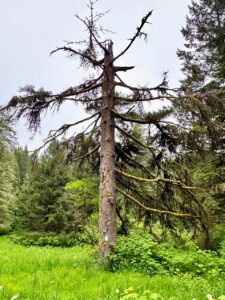
Brett and Ruth quickly corrected me: that snag is very much alive.
We paused on the adjacent section of trail and talked about snags in general, and the BPT snag in particular.
The Giving Tree
Given the cultivated aesthetic of Hoyt Arboretum, snags can look like eyesores to the casual observer. Many have signs attached, explaining that they provide wildlife habitat. That’s true, but it may be an understatement.
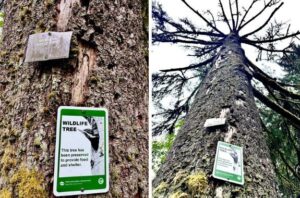
Snags are ecological pillars, supporting the local ecosystem in profound ways. Birds, bees, and other species rely on the snag’s dead wood for food and shelter. Dying trees provide critical habitat that healthy trees simply do not.
The BPT snag is still living, at least in part. The side facing away from the trail has green needles, which suggests some of the tree’s xylem is still intact. (Xylem is the vascular transport tissue within a tree that draws water and nutrients from roots to branches.)
Embrace the Wonder
Before my eyes, the BPT snag transformed from a broken background tree into the most interesting and important tree in the area. I felt that childlike joy and wonder that comes from suddenly seeing something in a whole new way.
Brett and Ruth are both skilled communicators — passionate, knowledgeable, and generous in sharing what they know. It was such a treat to hear them talk.
These are the kinds of experiences you can have when you visit or volunteer at Hoyt Arboretum. Stay open to adventure and wonder, and it will find you.
About the Author
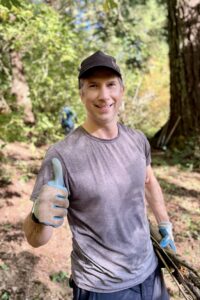 Spencer Miller grew up near a forest in North Carolina. He spent a lot of his childhood climbing trees and playing in the woods. After many years of adulting, he’s happy to return to the woods and reconnect with the sense of adventure and wonder.