
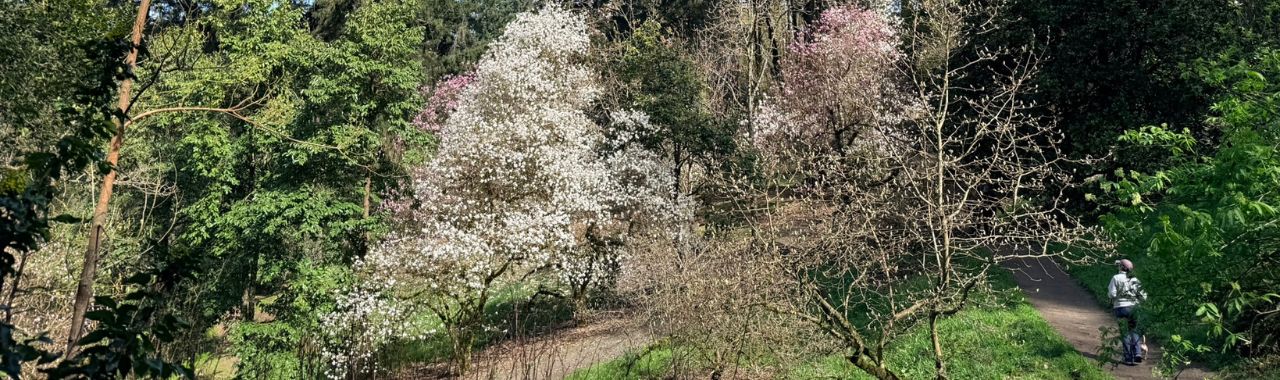
Spring at Hoyt Arboretum arrives quietly at first—soft light, tender new leaves, and the earliest hints of colourful blooms returning to the landscape. After months of cold, stillness, and uncertainty, the season reminds us that life always finds a way. Each bud, each unfolding leaf, carries its own small message of hope: that growth continues, that beauty returns, and that the world is always preparing to begin again.
As we move deeper into spring and the signs around us become unmistakable, this is truly one of the best times of the year to visit Hoyt Arboretum. Alongside the interesting leaf shapes and morphology that help us identify trees, the colourful blooms—and often their scent—offer additional clues that make tree identification in spring very enjoyable.
Welcome to my Spring Guide
Here is a small collection of my spring favourites, chosen for their lovely shapes and colours, along with a few quick pointers to help you identify them during the spring months at Hoyt Arboretum.
1. VINE MAPLE
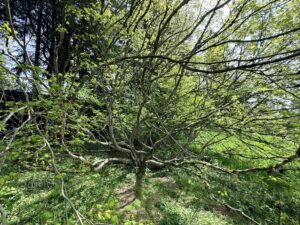
A beloved Pacific Northwest native, vine maples (Acer circinatum) is a graceful understory tree with arching, vine-like branches that can be found throughout the park on nearly every trail.
The species name ‘circinatum’ refers to the tree’s distinctive round‑shaped leaves, which make it especially recognizable in spring.
Look for these leaf features:
- 7 to 9 lobes with shallow sinuses (the gentle dips between the lobes)
- Nearly circular leaves, 2 to 5 inches wide, with a balanced, fan‑like symmetry
- Serrated, toothed edges that give the leaf a delicate texture
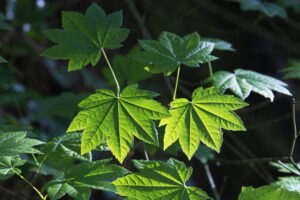
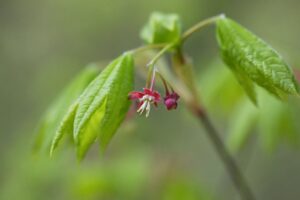
In spring, the fresh green leaves are especially striking, and by autumn they transform into vibrant shades of red, orange, and gold—one of the many reasons Vine maple is cherished throughout the region. In spring, the drooping clusters of delicate white blooms surrounded by red-pink ‘tepals’ make this tree especially unique and easy to recognize.
IUCN Red List Status: Least Concern
2. PINK LOEBNER MAGNOLIA
As spring commences, the nationally accredited Magnolia Collection at Hoyt Arboretum comes into full bloom, filling the landscape with enchanting colour. As you approach Magnolia Trail from Beech Trail across Upper Cascade Drive, the beautiful Magnolia blossoms appear between the still‑bare branches of the beech trees—an early sign that spring has truly arrived.
One of the universally adored highlights here is the Pink Loebner Magnolia (Magnolia × loebneri ‘Leonard Messel’).
Many magnolias, including this cultivar are “precocious” bloomers that flower before their leaves emerge later in the spring. Early in the season you can identify this cultivar by their fuchsia‑pink buds that open into starburst‑shaped flowers of lilac pink and white, creating one of the most memorable displays along the trail.
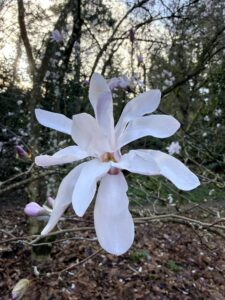
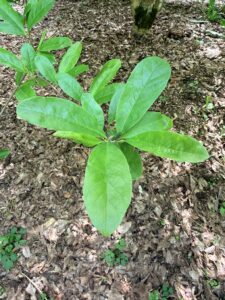
Later in the season, leaves sprout while blooms and their remnants persist for a short time. At this point, look for the following leaf features:
- Oblong, teardrop‑shaped leaves, 3 to 6 inches long and 1 to 3 inches wide
- Widest at the middle or toward the tip, giving the leaf a balanced, elegant form
- Smooth, entire margins running along the edges, ending in a pointed tip
- Soft, fine hairs (pubescence) that may cover the leaf surface
IUCN Red List Status: Cultivated variety- not evaluated
3. DOTTED HAWTHORN
In spring, as you stand at the start of Hawthorn Trail where it intersects with Maple Trail—just past the Mountain Ash Collection—you may notice a sweet fragrance drifting through the air. Follow the bees toward the source and you will find the dotted hawthorn (Crataegus punctata), adorned with clusters of delicate white blooms that make it especially striking this time of year.
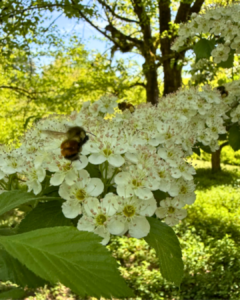
Look for the following leaf features:
- Leaves 2.5–6 cm long and 1.5–4.5 cm wide
- Deeply impressed veins, giving the leaf a textured, almost quilted appearance
- Alternate leaves, each attached singly at a node and often clustered on short, thick twigs
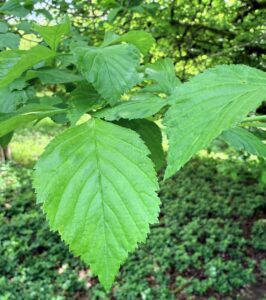
The name “hawthorn” comes from the old English word haw, meaning “fruit,” paired with the tree’s characteristic thorns. Today, it is a common yard trees in the Pacific Northwest.
IUCN Red List: Least Concern
4. SHIROFUGEN CHERRY
Just across from Wildwood Trail near the water tank stands a grand, flowering Japanese cherry tree that is well worth a pause in spring. Its large, fragrant, double blossoms transition from deep pink buds to white, and eventually fade to a striking magenta‑pink. The blooms resemble miniature roses, and if you listen closely, you may even hear the gentle buzz of bees moving from flower to flower.
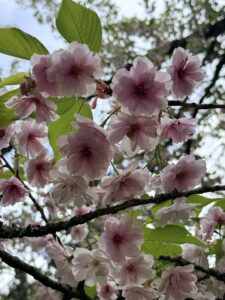
This is the Shirofugen cherry (Prunus serrulata ‘Shirofugen’), one of the most elegant spring highlights at Hoyt Arboretum. The Shirofugen cherry leaves have the following features:
- Ovate or lance-shaped leaves
- Serrated or toothed leaf edges
- Leaves approximately 4 inches long
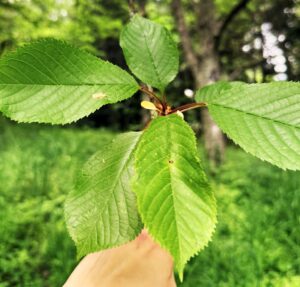
The foliage is known for its distinct colour transitions throughout the seasons:
Spring – coppery red or bronze
Summer – deep, dark green
Autumn – warm tones of bronze‑orange, yellow, or orange‑red.
IUCN Red List Status: Cultivated variety – not evaluated
Until the Next Season’s Walk
Spring is a season that brings new growth, colourful blooms, and a sense of hope and positivity that feels especially vivid on the trails. Each of these spring favourites offers its own way of inviting us to slow down, calling us to look closely, and appreciate the small transformations happening all around us. Whether it is the fragrance of cherry blossoms, the delicate texture of unfolding leaves, or the bright clusters of early blooms, these signs of spring remind us how alive the Arboretum becomes at this time of year.
As the season continues, I hope this guide helps you notice something new on your walks—an unexpected colour, a leaf shape you had not seen before, or a tree you now recognize with confidence. Spring never stays long, but its beauty lingers in the details we take the time to observe. I look forward to returning to the trails soon and seeing how the Arboretum continues to grow and change with each season.
See you again next season!
About the Author
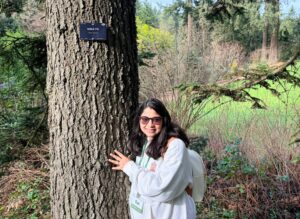 Sailatha Theagaraj (she/ her/hers) is a recent volunteer at Hoyt Arboretum, having moved to the region not long ago. Sai holds a Master’s degree in Environmental Science and Technology and brings global experience in environmental sustainability, sustainability consulting, green building certifications, and circular economy work. She has led sustainability initiatives for major infrastructure projects and has trained many professionals in environmental sustainability practices. Her favourite places in the Arboretum are the Conifer Collection and enjoying a quiet moment at the Stevens Pavilion, listening to the surrounding sounds of nature. She is passionate about conservation, sustainability education, and environmental awareness.