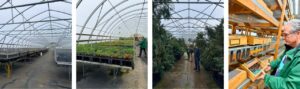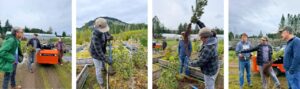
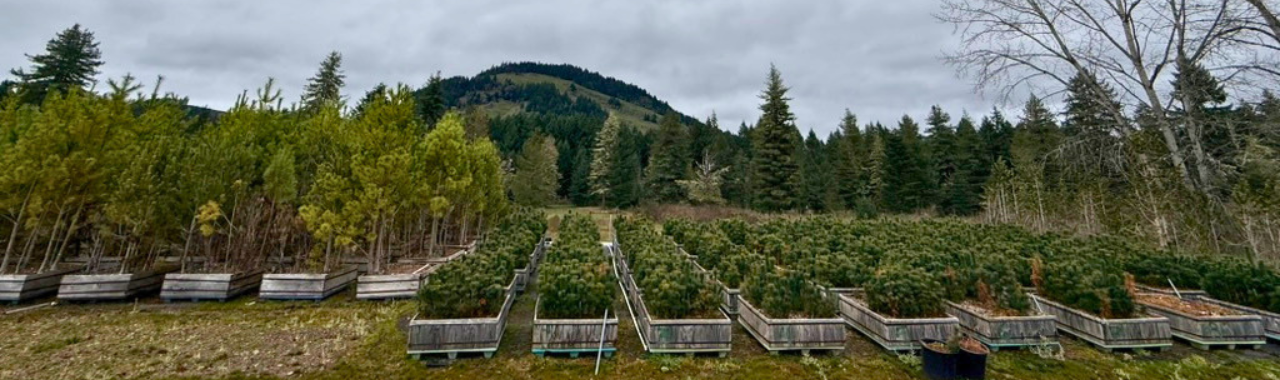
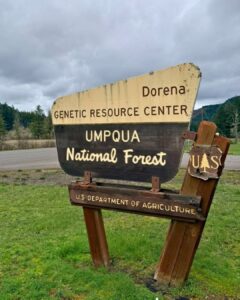
On a recent visit to the Dorena Genetic Resource Center near Cottage Grove, Hoyt Arboretum staff stepped into one of the country’s leading quantitative resistance research facilities and saw, firsthand, how science is helping forests keep pace with fast-moving threats.
What’s happening at Dorena isn’t abstract. It’s hands-on, large-scale, and urgent.
What Is Quantitative Resistance?
Dorena’s approach is rooted in scale. Rather than waiting decades for molecular or genetic breakthroughs, their teams grow and test thousands of trees at once, identifying natural resistance through exposure.
Seedlings are inoculated with thousands of spores at two years old and are monitored for their resistance levels. Some might show no signs of disease, some might show slight signs, and some may be heavily effected.
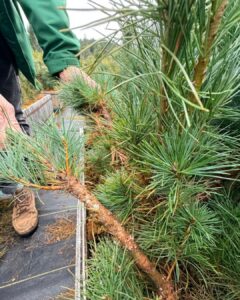
The survivors are selected, bred, and tested again. Over time, this builds resistance across generations. It’s a numbers game, and one designed to move as quickly as possible in the face of accelerating threats.
A Field of Evidence
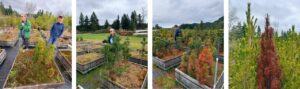
At Dorena, trees move from greenhouse benches to expansive outdoor field trials, where thousands of individuals are lined up side by side on pallets. Here, resistance becomes visible.
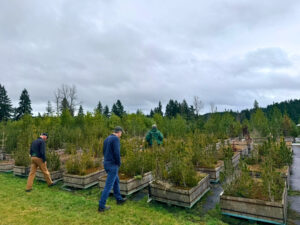
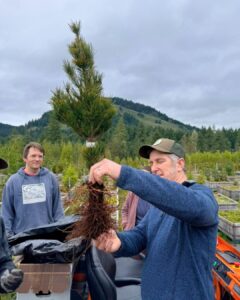
Forest Geneticist Richard Sniezko gave our group the grand tour of Dorena’s facilities. Starting in the field, he lead us to a planter box that included both resistant and non-resistant stock grown side-by-side split down the middle. The dividing line in the box was striking. On one side only moss and small plants has grown in where the non-resistant trees had died, while healthy young trees from the resistant stock stood proud on the other.
As we moved through the rows of planter boxes, the stories of those same types of resistance tests continued to be evident.
Trees for the Future
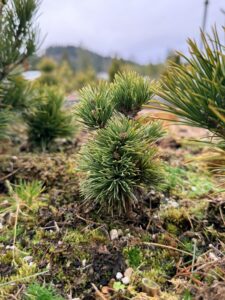
From this visit, Hoyt Arboretum brought back whitebark pine and foxtail pine selected for resistance to white pine blister rust, a disease that has reshaped high-elevation forests across the West.
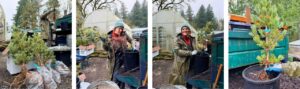
White pine blister rust, caused by an introduced fungus, has devastated populations of five-needle pines for over a century and continues to spread across their range.
In places like Crater Lake, the outlook once seemed dire. Early predictions suggested widespread loss of whitebark pine, but decades of work (including resistance programs like those at Dorena) are changing that trajectory.
Check out a recent OPB story on saving whitebark pine at Crater Lake.
Both whitebark and foxtail pine are now considered priority species for conservation. These resistant seedlings represent a tangible step toward ensuring they persist in the landscape.
A Partnership in Practice
Resistance work is deeply collaborative, requiring coordinated teams, long-term trials, and decades of data. At Hoyt Arboretum, that collaboration takes two forms: growing resistant trees in the landscape and tracking how they perform over time, and contributing Oregon ash seed to support early resistance work against emerald ash borer.
This collaboration builds on past success. In 2015, the U.S. Forest Service replaced Port Orford cedars lost at Hoyt Arboretum to Phytophthora root rot with resistant stock developed at Dorena. Today, those trees are thriving along the connector trail between Redwood Trail and Bray Lane.
(If you’re visiting, stop and see them! There’s a sign that shares the story.)