
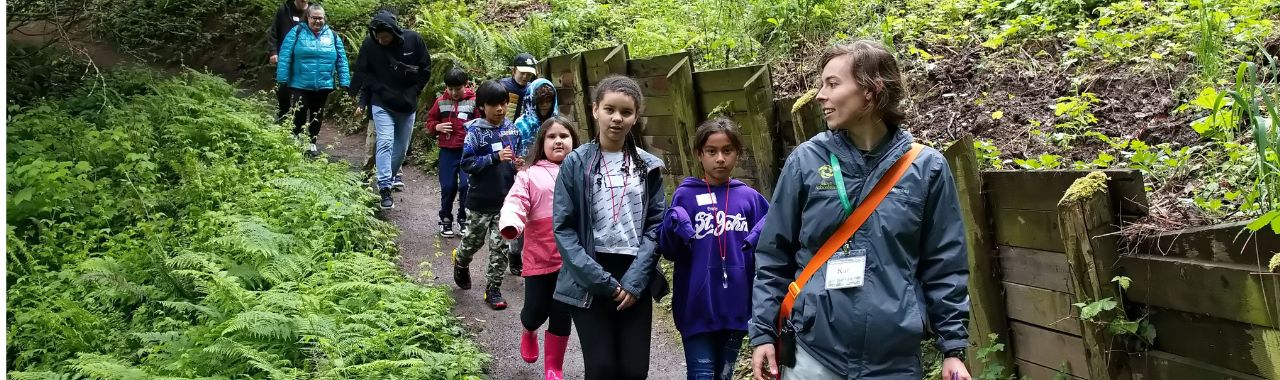
On a rainy spring morning in 2022, a bus full of elementary school students crossed the Fremont Bridge for the first time. Some of them screamed—not from fear, but from wonder. They had never crossed a river before. A few thought it was the ocean.
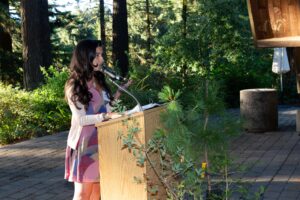 For Natalie Camelio, a teacher at Scott Elementary, moments like that are exactly why she brings her students to Hoyt Arboretum—and why she now serves on the Board of Directors of Hoyt Arboretum Friends (HAF).
“I don’t remember the tests I took or the worksheets I did in school,” Natalie told HAF supporters at the Forage in the Forest fundraiser that same year, “but I do remember the hands-on experiences and the field trips.”
A Classroom Without Walls
In 2022, Natalie’s fourth graders had just returned to in-person learning after the pandemic and hadn’t been on a field trip since their first-grade visit to the zoo.
Scott Elementary is Spanish Immersion, Title I, and Title X school, serving students from around the world— some who are new immigrants, and some who are navigating housing instability. For many of Natalie’s students, access to green space is limited—or nonexistent. So, “as soon as it was deemed safe,” she said, “I booked a field trip to Hoyt Arboretum.”
Learning happens differently the second time
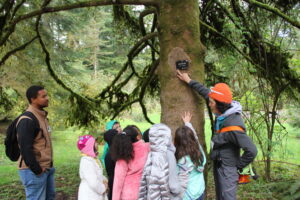
Now seven years into her teaching career, Natalie has continued to bring her students on field trips to the Arboretum every year through the support of Hoyt Arboretum Friends’ field trip scholarship program, which covers their transportation costs and program fees.
And, in 2024, she was one of the first teachers to pilot Hoyt Arboretum’s multi-visit field trip model, where elementary school students visit the Arboretum twice during the school year in both fall and spring. She immediately noticed a difference.
“On the first visit, everything is new,” she shared, “The excitement of stepping into the forest—especially for kids who haven’t spent much time outdoors—can overwhelm the learning objectives. But on the second visit, something shifts. They’re excited to go back, and they start really noticing things like seasonal changes.”
On one of their first visits, the weather was classic Oregon: cold, soaking rain. By the end of the day, the kids were wet and miserable—and it turned out to be one of the most powerful learning experiences of the year.
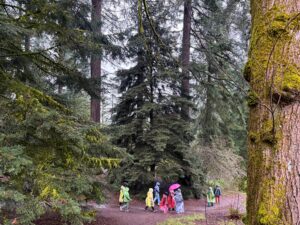
“Most of the time, kids only go outside when it’s sunny,” Natalie explained. “So being in the forest in the rain was totally new. They noticed how the air smelled different. How the forest felt quieter. How being under the canopy meant you didn’t get quite as wet.”
When they returned on a sunny day, they noticed those changes too. At Hoyt, staff often joke when kids arrive on a clear day: They lucked out. But Natalie reframed that idea entirely.
Belonging in the forest
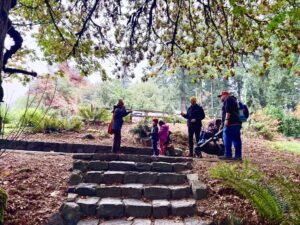 Because Scott is a Spanish immersion school, Natalie often works closely with HAF staff to ensure students can fully participate. Spanish-speaking nature educators lead groups for students who need them. Moreover, ADA-accessible trails make it possible for students with mobility devices or those in their “intensive skills classroom” to explore alongside their peers.
These details matter—because access is never guaranteed.
Thanks to our members, field trips for Scott Elementary and any school that needs it are free. In 2025 alone, HAF hosted 7,200 students on field trips and 78% of those kids attended through our scholarship program.
That includes program fees, professional educators, and transportation—the buses that carry students across bridges they’ve never crossed before, into forests they’ve never seen.
From partner teacher to board member
When HAF’s Education Director reached out to Natalie about applying to join our Board, her first reaction was hesitation.
“I thought it sounded fancy,” she said. “And very different from things I’d done before.”
But once she joined, she realized her perspective as a teacher—and as a partner educator who regularly brings students to Hoyt—was not only welcome, but essential.
“I already feel like my feedback is valuable,” she said. “Suggestions I’ve made about field trips have already been implemented.”
Natalie originally imagined a career in environmental education. While she now teaches in a traditional classroom, her mission hasn’t changed.
“Ultimately, my goal is to get more kids into nature,” she said. “I think I can have a greater impact by bringing those principles into everyday learning—and by helping shape programs like these.”
Natalie shared a story about her mother, who had to learn how to identify every tree on her street as part of her own school curriculum.
“Kids today can recognize 50 logos,” she said. “But maybe not five trees.”
By serving on HAF’s board, Natalie hopes to help change that.
Why it matters—and how you help
These experiences happen because members and donors believe that every child deserves the chance to cross a bridge, step into a forest, and discover that learning doesn’t only happen at a desk.
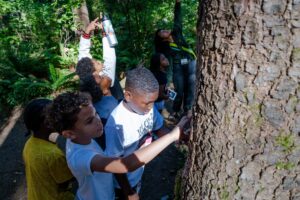
When you give to Hoyt Arboretum Friends, you’re not just supporting trees—you’re supporting students, teachers, and moments of discovery that last a lifetime. Make a donation.