
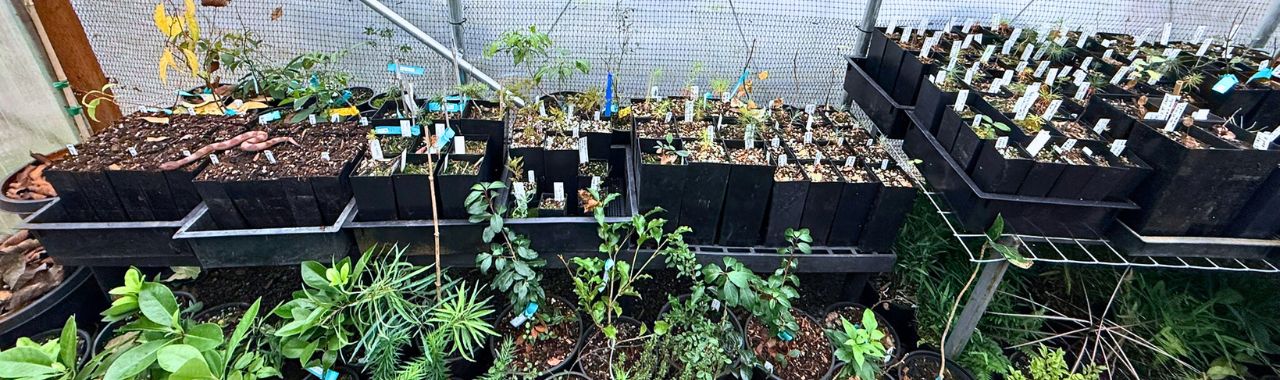
If you were to sneak a peek into Hoyt Arboretum’s maintenance yard, the first things you’d notice might be the practical signs of a working natural area: tightly packed work trucks, shelving stacked floor-to-ceiling with shovels, rakes, pruners, and handsaws, bins of organized work gloves, and everything necessary for everyday stewardship.
But—past the tools and gear, and off to the edges tucked into surrounding vegetation—is where the real magic happens.
New Seedlings
Last week, I followed Hoyt Arboretum’s Curator, Martin Nicholson, deeper into “the yard” for a glimpse at the future of Hoyt Arboretum. First, he lifted the lid to a propagation table and pointed to a tray of small seedlings, just little red stems curved with a drooping bobble at the end–the “testa” or “seed coat”.
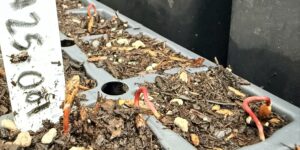
“Pinus balfouriana austrina,” he said in his soft New Zealand accent. Before he could move on to his next point, I pulled out my notes app and asked for that name one more time. With an appraising look, he clarifies: “Southern foxtail pines”–switching to the common name like he’s used to doing with the public.
I take a closer look at the tray, and learn that these fragile little sprouts are the descendants of one of the toughest, rarest conifers in the United States.
“This subspecies grows in really surprising locations,” Martin says, “sometimes straight out of a crag in a cliff face. They survive extreme heat, drought, high elevation.”
And yet, their home range is shrinking. Wildfire. Shifting climate patterns. Each year, the native habitat where these ancient trees can survive gets narrower. But here—on a chilly morning in a Portland maintenance yard—their future seems a little brighter.
Martin closed the propagation table carefully, making sure the heaters were on and that hungry rodents couldn’t sneak inside. Then, he led me just a few steps to the left and opened the door to the nursery, where larger saplings spring up in a safely enclosed environment.
Older Saplings
Inside, he opened a small cage constructed from PVC and hardware cloth and dozens of skinny young pines came into focus, each topped with a cheerful little green pom-pom of needles.
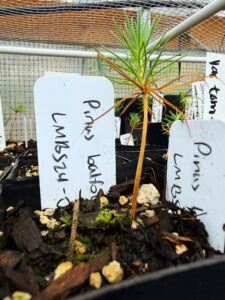
“We collected these last year,” he said, pointing to little pots with tags labeled: Pinus balfouriana subsp balfouriana.
“These are the Northern foxtail pines,” Martin continues, “they’re geographically separated from the southern population. It’s the same species, but it’s adapted to a fairly different climate.”
Collecting from across a species’ entire range is essential for ex situ conservation—it preserves the full sweep of genetic diversity these trees evolved to survive.
Together, the two subspecies represent Hoyt Arboretum’s commitment to conservation and preparation. We’re safeguarding species whose future in the wild is uncertain—and selecting the ones that can thrive in Portland’s changing climate.
How We Prepare for a Changing Climate
These foxtail pines may be rare, but they’re also climate-forward. According to the Climate Assessment Tool (CAT)–developed by Botanic Gardens Conservation International, Portland’s projected conditions in 2050 and 2090 align closely with the environments where these trees already grow (see figures below).
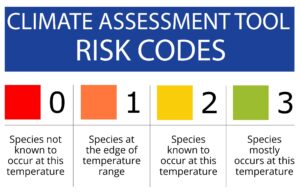
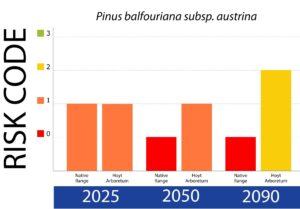
Native populations of foxtail pines face risk from wildfire and heat, yet here at Hoyt, they are expected to perform better in projected conditions. What we see sprouting now are trees meant for the Portland of 2050 and beyond, so future generations may enjoy the towering canopy of Hoyt Arboretum the way we do today.
Seed Collections
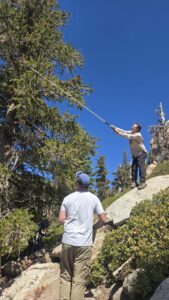
This year, Martin made 84 seed collections from 42 species in the Sierra Nevada Mountains in California. Along with the Southern foxtail pine, two other conservation priority species including Piute cypress and Sierra juniper were collected.
All three are at risk in the wild and are underrepresented in botanic gardens.
Some of those seeds will grow here at Hoyt, and some will be shared with partner gardens, expanding the living genetic “backup copies” of rare species.
Thanks to support from Hoyt Arboretum Friends’ members and grants from partners like the American Public Gardens Association and the American Conifer Society, those seeds are already germinating.
Keeping Hoyt Arboretum Evergreen
Climate adaptation doesn’t happen in a single season. Or a single year. In fact, these foxtail pines will need to spend 5 to 7 years growing in the nursery before they can be planted along the trails.
This work takes steadiness, commitment, and care—the same qualities our Evergreen Circle monthly donors provide.
Monthly giving allows us to:
- Send Martin on seed collection trips
- Purchase pots, soil, tools, and nursery supplies
- Support interns learning this conservation work firsthand
- Update and expand propagation tables, the nursery, and greenhouse
- Rent greenhouse space when our nursery overflows
- Plant the right trees, in the right places, at the right moment
Your monthly gift helps ensure the forest you love at Hoyt Arboretum will be thriving long into the next century.
Join the Evergreen Circle by making a monthly gift to Hoyt Arboretum Friends.
About the Author
 Rebekah Golden is the Communications Coordinator for Hoyt Arboretum Friends (HAF). Before her work with HAF, Rebekah earned a degree in Ecology and Evolutionary Biology from the University of Arizona. She moved to Portland where she worked with partners to launch a business that brought increased awareness to local bees and pollinators.