
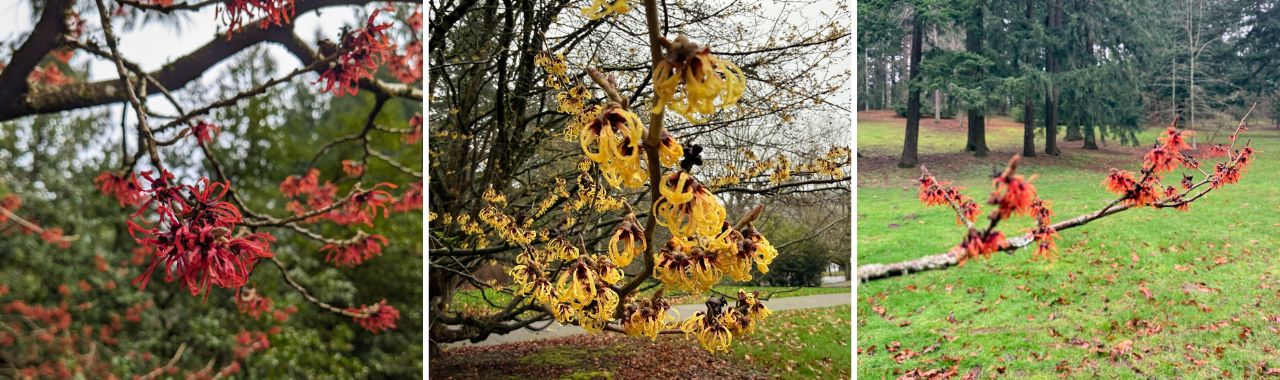
At Hoyt Arboretum, our trails are more than paths through the forest—they’re galleries in a living museum, where trees and shrubs are thoughtfully arranged like exhibits. And this time of year, the Witch Hazel Exhibit steals the show as their signature, spidery flowers begin to unfurl.
Some Botanical Background
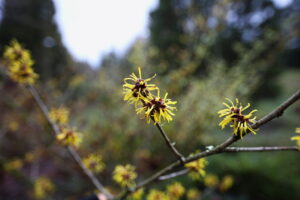
Witch hazels (Hamamelis) are full of botanical magic. Their oval leaves grow alternately along the branches, and the genus name Hamamelis means “together with fruit,” a nod to the unusual way flowers bloom at the same time last year’s fruit is still maturing. Most species flower from January to March, producing slender, ribbon-like petals in shades of yellow, orange, or red.
Their fruit capsules ripen months later and split open with a snap—launching shiny black seeds up to 12 feet away, earning them the nickname “snapping hazel.” Here’s a slow motion video of the seed dispersal method by Duke University.
Lessons in Etymology
The name “witch hazel” isn’t about hexes and spells—it comes from the Old English wice, meaning “pliant” or “bendable,” referring to the flexible wood that makes for good bows and divining rods. Then “Hazel” comes from the leaf shape, which resembles that of hazelnuts.
Witch Hazels at Hoyt Arboretum
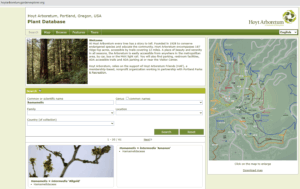
There are more than 60 taxa in the genus Hamamelis at Hoyt Arboretum, and if you’d like, you can explore them all in our Plant Database. Use the Search function and enter ‘Hamamelis’ in the common or scientific name field for a full list of taxa, which you may click for more information about the species and its location in the park.
Most of the witch hazel collection can be found near and around the Vietnam Veterans of Oregon Memorial, close by at the start of Wildwood Trail, and in the parking lot plantings across the street from the Memorial.
A Few Favorites
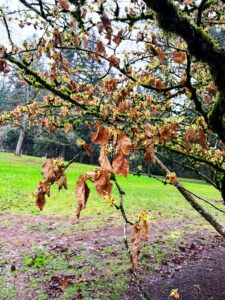
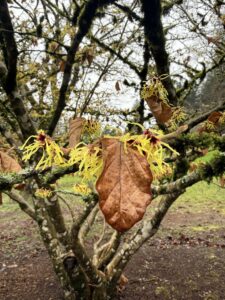
Hamamelis mollis ‘Westerstede’

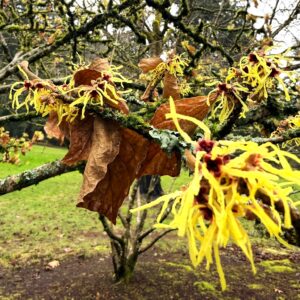
Just near the entrance to the Vietnam Veterans of Oregon memorial, this garden-origin cultivar has grown to an impressive size and displays thousands of flowers. At this observation, the plant also held onto dead leaves through to blooming, and gives it a charming ‘shaggy’ look.
Hamamelis × intermedia ‘Fire Charm’

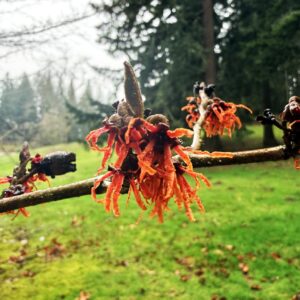
A little further up the connector trail and toward the parking lot, you’ll find a group planting of larger Hamamelis, with one bright red cultivar.
Hamamelis mollis ‘Early Bright’

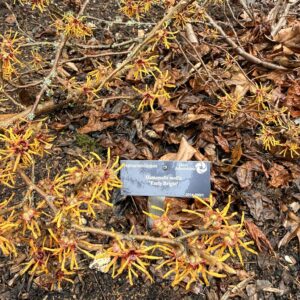
This cultivar wins the best fragrance award in the exhibit, and is worth stopping in the parking lot off Knights Blvd for a sniff! It is a smaller plant on the north side of the lot. The label is clearly visible in the ground at the site.
Late Winter Exhibition
Like any great museum, our exhibits shift with the seasons—and right now, witch hazels are the feature display. While our evergreen conifers, hollies, and winter gardens shine all season long, these late-winter bloomers are the changing stars of the moment, bringing spring vibes to the trails just when we need it most.
About the Author
 Rebekah Golden is the Communications Specialist for Hoyt Arboretum Friends (HAF). Before her work with HAF, Rebekah earned a degree in Ecology and Evolutionary Biology from the University of Arizona. She moved to Portland where she worked with partners to launch a business that brought increased awareness to local bees and pollinators.