
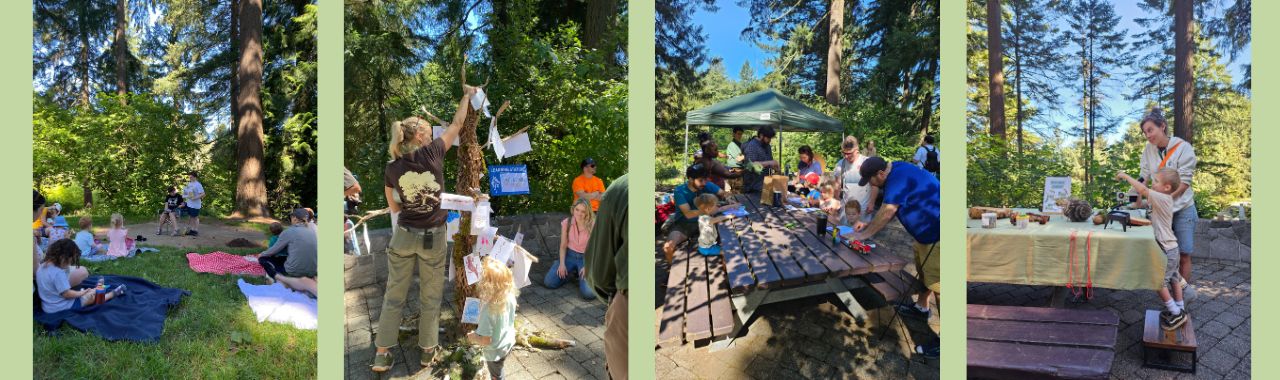
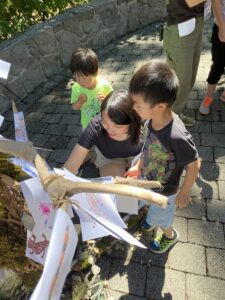
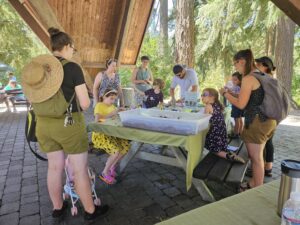
How many animals do you know that live in trees? The classics like squirrels, birds, and maybe even raccoons might come to mind. But have you ever given any thought to beetle galleries? These are the patterns created by bark beetles as they eat away at old, decaying trees and were one of many habitat indicators that we explored on our guided hike at Family Forest Day. As bubbles and excited conversations drifted through the Stevens Pavilion, families explored the many ways that Trees are Homes through nature crafts, story time, and other hands-on activities that explored the forest as a vibrant habitat. As an educator, I got to experience the joy of all of the great things that Family Forest Day has to offer, by helping at many booths and leading a bilingual (English and Spanish) nature walk.
That day, we welcomed over 200 participants, including youth and families from Portland and beyond, to explore the many ways that trees and forests provide food, shelter, and other necessities for wildlife to thrive. From building insect hotels to making leaf rubbings, learning about injured bird care, and joining guided walks, kids were able to learn about how forests support life at every level. There was even a treasure hunt leading to a Big Leaf Maple, an extra important habitat tree, where a box of Douglas Fir temporary tattoos was hidden in the leaf litter. Each activity was designed to encourage young learners to connect with the ideas of trees as living homes for animals, as well as for fungi, lichens, and even mosses or other small plants. This year felt especially meaningful, as we expanded our bilingual programming, offering materials and guided walks in Spanish to make the experience more welcoming and inclusive for all families.
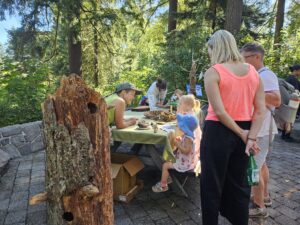
According to the U.S. Census Bureau, approximately 12% of youth in Portland speak Spanish at home. With that in mind, we were excited to officially offer bilingual opportunities at Family Forest Day for the first time ever. This included both a fully Spanish-speaking guided walk with one of our Nature Educators, Naomi, and a bilingual guided walk, which I had the joy of leading. Leading the bilingual or, more accurately, Spanglish walk was definitely the highlight of Family Forest Day for me. It was amazing to be able to connect with folks across multiple languages, and help everyone explore the wonders of the natural habitats here at Hoyt in a way that was most meaningful for them.
Activities and curricula for Family Forest Days are mostly geared toward children, but I was also able to answer questions for some of the Spanish-speaking adults on the tour. We even had a couple who joined as a means to practice their language skills! Being able to connect with folks of all ages and linguistic abilities made the walk even more meaningful, and further emphasized the importance of offering these opportunities for everyone to explore nature.
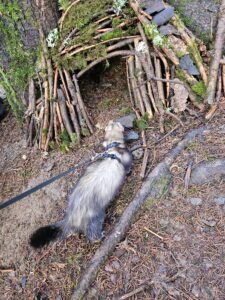
I myself learned new words as we chatted about the many plants and animals that can be found at Hoyt Arboretum. This included the word “hurón,” meaning “ferret” in a silly instance where one of the visitors misheard me when I introduced them to the Fairy Forest (I can report that there have indeed been ferrets in the Fairy Forest at least once when my friend brought her pet, Doran, to visit last year).
After a quick discussion of fairy habitats, we investigated habitat components from different trees and plants, to even the gravel piles, which provide excellent sunning and hiding spots for garter snakes. We discussed what different animals eat, from herbivorous squirrels to carnivorous barred owls, and explored some possible food sources, like berry bushes. And, of course, we ended the hike with some bug-hunting at the stumps in the sunshine. The nature walk was a true highlight for me and the many folks who expressed their gratitude for having this opportunity to get better connected with nature and with Hoyt Arboretum as a space to explore.
Overall, Family Forest Day was a delightful experience, and I am very much looking forward to the next one. Make sure you join us on August 16th in order to meet your new Best Tree Forever (BTF is the new BFF). We hope to see you there!
About the Author
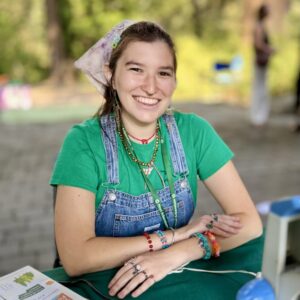
Rowan Moreno is the Community Engagement Coordinator with Hoyt Arboretum Friends. They graduated with a B.A. in Biology from Lewis & Clark College in 2023, where they studied plant biology and conservation, worked as the Student Herbarium Curator, and created a practicum focused on natural dyes and ethnobotany. Rowan began working at Hoyt as the Collections Intern following graduation, and later became the Collections Assistant and a Nature Educator before stepping into their current role. Their favorite part of the Arboretum is probably the Creek Trail since it’s a beautiful place to explore, especially on a hot day, but the Oak Collection also holds a special place in their heart since that is where their Hoyt career began.