
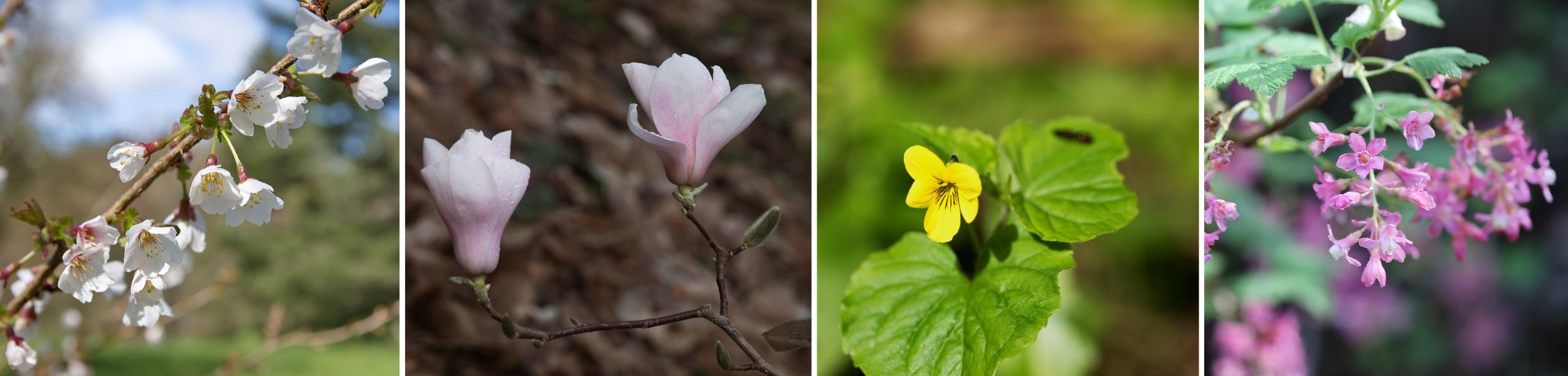
Spring arrives in bursts at Hoyt Arboretum, and each year brings its own unique rhythm of blooms. While temperature, sunlight, and rainfall all influence when trees and wildflowers bloom, you can expect the landscape to come alive with color throughout March, April, and May 2026.
Don’t miss our nationally accredited Magnolia Collection, which offers a spectacular display of blossoms along the Arboretum trails. Equally dazzling is the Rosaceae Collection, featuring cherries, apples, crabapples, plums, and other blooming trees that add delicate fragrance and color to the park.
Beyond these collections, Hoyt Arboretum’s trails are sprinkled with flowering shrubs, perennials, and wildflowers, creating a tapestry of blooms across the landscape. While we can’t capture every blossom, we’ll share standout spots each week to help you enjoy spring’s fleeting beauty.
Follow along as we highlight one great spot every week—check back often and let the season’s blossoms guide your next visit.
Tuesday, May 26, 2026
Following Memorial Day, and into the last week of May, we seem to have come to the natural conclusion of the 2026 Spring Blossom Tracker at Hoyt Arboretum. The park will continue to bloom along the trails, particularly in the understory and in plantings around structures through the summer, but the spectacle of the flowering tree collections has all but wrapped for the season.
Taking the path of Overlook Trail to Wildwood, the salal is abundantly flowering and will continue for many weeks before fruiting.
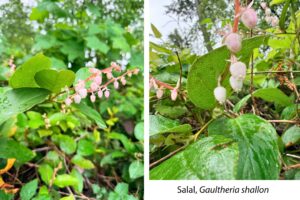
Wildwood Trail is particularly lush and green this week, with cameos from special guides and wildlife, though blooms are mostly limited to wildflowers like buttercups and daisies.

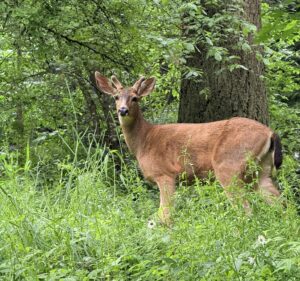 Wildlife on Wildwood
3 deer on Wildwood Trail near the water tank at Hoyt Arboretum on 5/26/2026 include 2 young does and a young buck. The 189 acre park is home to wildlife, and precautions to protect young and sensitive trees like cages are used.
There have also been coyote sightings in this area this week. Coyotes are wary of humans and tend to keep their distance, however, we encourage everyone to follow leash laws and keep pets near to prevent territorial behavior.
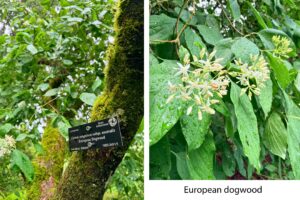
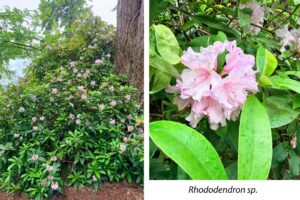
Continuing to Hawthorn Trail along the Water Tank, some dogwoods and a massive rhododendron remain in bloom through the wet weather.
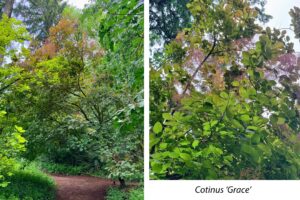
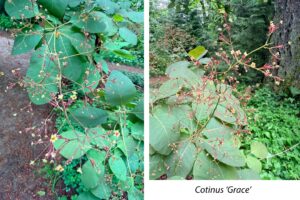
Following Hawthorn Trail around the bend, parallel to Wildwood Trail and heading toward Walnut Trail is Hoyt Arboretum’s curator, Martin Nicholson’s favorite trees of the late spring, summer season. Cotinus ‘Grace’. A hybrid between American smoke tree, (Cotinus obovatus) and Cotinus coggygria ‘Velvet Cloak’, it is grown for its enormous clusters of flowers, frothy, pink panicles reach fourteen inches high and twelve inches wide [Great Plant Picks]. The cotinus at Hoyt is just beginning to bloom, and should put on quite a display when the weather dries out and heats up.
Tuesday, May 19, 2026
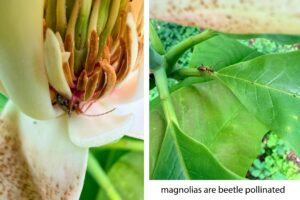
The late spring has brought us back to Magnolia Trail. With more than 143 magnolia trees including 42 species and 34 cultivars from around the world, the collections are designed to bloom in succession offering new highlights week by week rather than a single, fleeting moment. Starting with the “umbrella tree”, Magnolia tripetala has its large obovate leaves and big, waxy flowers at the same time.
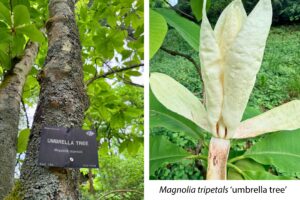
By taking a closer look at these impressive blooms, this explorer was reminded that magnolias are beetle pollinated, as several little beetles with long antennae poked around the inside of the upright blooms.
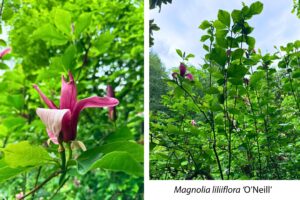
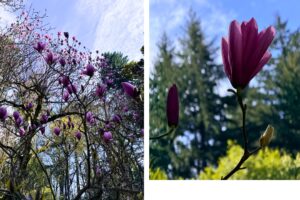
Further up Magnolia Trail, before the switchbacks toward Wildwood Trail, there is a small group of Magnolia liliiflora cultivars still hanging onto their lovely purple blooms while the branches leaf out. The color contrast of bloom against greenery is truly lovely.
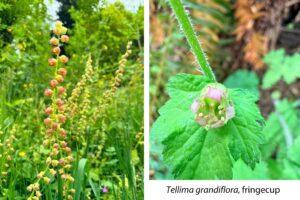
Along the trail and particularly up the Magnolia Trail switchbacks, there is an abundant group of native wildflowers. Fringecup (Tellima grandiflora) is a resilient, herbaceous perennial native to the Pacific Northwest. Thriving in damp woodland shade, it features spikes of bell-shaped, distinctively fringed flowers that transition from greenish-white to reddish-pink over fuzzy, heart-shaped leaves.
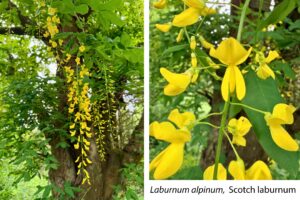
Past the switchbacks and toward Overlook, unique chains of yellow flowers droop down like tassels from Laburnum alpinum, or Scotch laburnum.
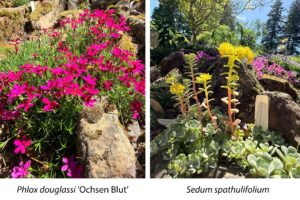
Back in the Visitor Center Courtyard, the alpine garden flowers continue to astound. This week, the Phlox and Sedums are particularly vibrant.
Tuesday, May 12, 2026
The flowering trees of Hoyt Arboretum are still going strong in many parts of the Arboretum. Exploring the flowering tree collections on the east side of Fairview Blvd is a feast for the senses, and a lovely way to soak up some Vitamin D on the sunny days in the forecast.
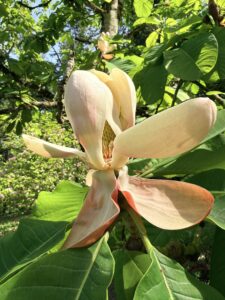
Along Magnolia Trail, the trees have leafed out, so the peak bloom display is now complete, however that does not mean the show is over. The magnolias that bloom after leafing (non-precocious) have started their magnificent displays. These later blooming magnolias tend to have very large, very fragrant blooms.
Flowers are not, however, contained to the flowering tree collections at Hoyt Arboretum, and you do not need to compromise between seeing seasonal blooms and the relief of a little shade. Hoyt Arboretum’s Nationally Accredited Conifer Collection is mostly planted along the trails on the west side of Fairview Blvd. Look up their towering heights for a shift in perspective, but also make sure to look down to take in the understory- comprised of many flowering natives buzzing with diverse native bee species.
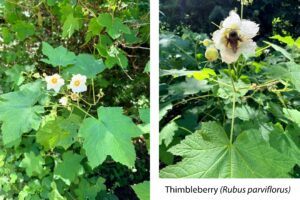
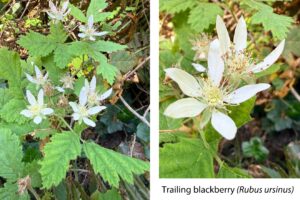
Native Rubus spp. are weaving their way throughout the Arboretum’s understory. Often found along trail edges, their lovely flowers offer the promise of berries soon to follow.
Thimbleberry (Rubus parviflorus)
With its large, soft leaves (affectionately known as nature’s toilet paper), thimbleberry creates a lush backdrop for its bright white flowers. The blooms are open and simple, with five distinct petals that stand out against the foliage and draw in pollinators.
Trailing blackberry (Rubus ursinus)
Low-growing and easy to overlook, trailing blackberry weaves along the ground beneath taller plants. Its delicate flowers can be found on separate male and female plants- an important distinction for fruiting later in the season. Unlike the invasive Himalayan blackberry, trailing blackberry stays close to the ground with finer stems and smaller leaves, rather than forming dense, thorny thickets.
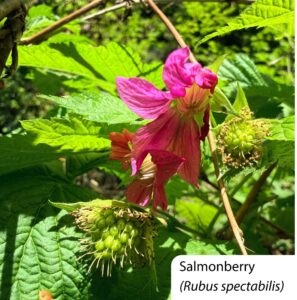
Salmonberry (Rubus spectabilis)
A familiar sight along the trails, salmonberry has been flowering for several weeks. Along Redwood Trail, some plants are holding onto their vivid fuchsia blooms even as the first berries begin to form, offering a glimpse of the seasonal transition already underway.
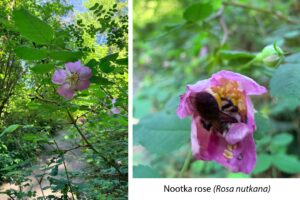
Nootka rose (Rosa nutkana)
This Pacific Northwest native is beginning to bloom with soft pink, five-petaled flowers that have a classic wild rose look and a light, sweet fragrance. Often found along sunny trail edges, Nootka rose brings a delicate brightness now, followed later in the season by showy red rose hips.
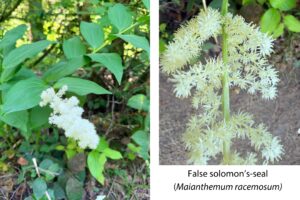
False Solomon’s seal (Maianthemum racemosum)
Arching stems lined with alternating leaves lead to feathery clusters of tiny white flowers at their tips, giving this plant a soft, airy presence in shaded understories. As the season progresses, these blooms will give way to speckled berries, extending the visual interest into summer.
Wildflowers in planting beds around Hoyt Arboretum’s infrastructure are also coming into vibrant bloom this week.
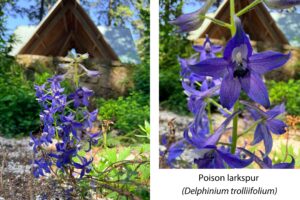
Poison larkspur (Delphinium trollifolium)
Planted with the Columbia River Gorge plants surrounding Stevens Pavilion, this native larkspur is sending up tall spikes of deep blue to purple flowers that stand out against the surrounding greenery. Each bloom has a distinctive spur at the back, giving the plant its name. While striking, all parts of this plant are toxic if consumed- so it’s one to admire with your eyes rather than your hands.
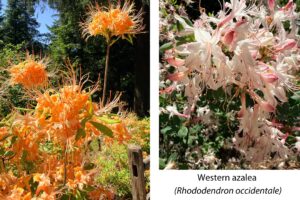
And heading back toward Fairview Blvd, a collection of Azeleas is also worth stopping to admire. Plants with pink, red, and orange blooms sport striking and very elongated anthers.
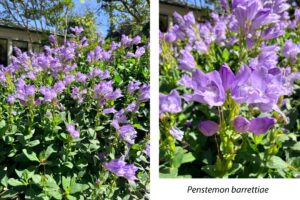
And crossing the road back to the Visitor Center Courtyard, the wildflowers planted in the Alpine rock garden beds are having their best year ever. Last year, large Doug-firs with butt rot were removed, opening up the space and providing more light. As a result, the penstemons are abundant, blooming, and buzzing with delight. For a pick-me-up, watch these plants closely as large-bodied bumble bees try to fit their rumps into the bell-shaped flowers.
Monday, May 4, 2026
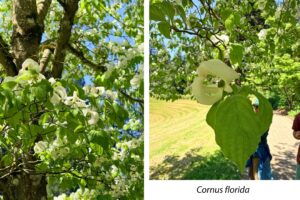
With the warming weather, new trees and shrubs are beginning to bloom all over the Arboretum, every day. The Dogwood Collection near the Vietnam Veteran’s of Oregon Memorial continue to be a highlight, with Cornus florida showing unique globe-shaped white bracts surrounding their budding and blooming flowers.
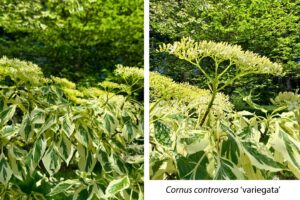
Another stunning dogwood, Cornus c0ntroversa ‘Variegata’ has incredible variegated leaves, a unique planar branching pattern, and flowers that pop up above the foliage on long stalks.
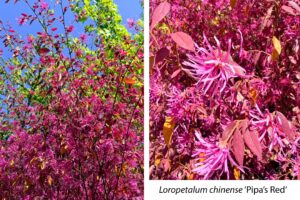
And just across the street is a pair of the most stunning parking lot plants you could imagine. Loropetalum chinense ‘Pipa’s red’ is a VIBRANT (no filter on these images), Chinese fringe flower cultivar. The genus name “Loro-petalum” translates to “long petals”- for the thin, spidery petals that make this plant so eye catching.
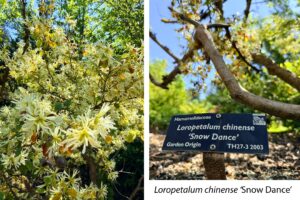
And another, smaller, less colorful, but equally beautiful cultivar Loropetalum chinense ‘Snow Dance” can be found directly adjacent.
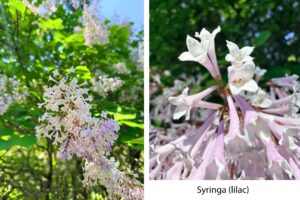
Crossing Kingston Drive and off trail, toward Maple Trail, there is a fragrant and stunning collection of Syringa (lilacs). The latin name originates from the Greek word syrinx, meaning “pipe” or “tube,” referring to the hollow stems of some species, which were historically used to create pipes or flutes. They are abundant with cone-shaped clusters of tubular flowers.
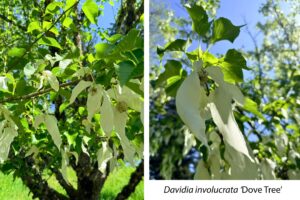
Back up on Maple Trail, a one of the most elegant blooms of the season can be found on Davidia involucrata, which you know is beloved by the number of common names it is known by: dove tree, ghost tree, and handkerchief tree being the most used. Its ‘blooms’ are inflorescences that feature two large, white bracts surrounding a purplish-red flower head.
Hoyt Arboretum’s curator, Martin Nicholson’s favorite hypothesis for why this flower shape evolved- is that the bracts form an umbrella shape over the flower to protect the pollen from getting wet-which would make it inviable.
Wednesday April 28, 2026
Spring blooms are in abundance along the trails of Hoyt Arboretum. Almost everywhere you look trees and shrubs are bursting with color and fragrance.
Flowers Everywhere!
View this post on Instagram
If you’re searching for spring blooms in the Arboretum, no path will disappoint, but this week the plantings around the Vietnam Veterans of Oregon Memorial are a must see.
At the entrance to the Garden of Solace, the crab apple plantings are a sweet, centering tribute to the Oregon residents who gave their lived in Vietnam.
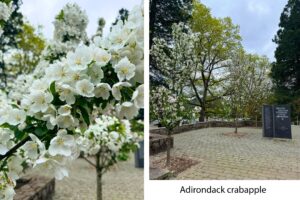
There are two main varieties, with a group of white-blooming trees at the entrance is Adirondack crabapple, Malus ‘Adirondack’.
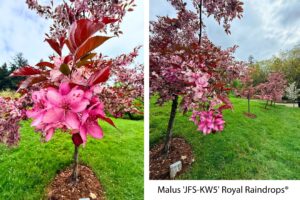
Following the path into the memorial ‘spiral’, there is a row of pink-blooming cultivar known as Malus ‘JFS-KW5’ Royal Raindrops.
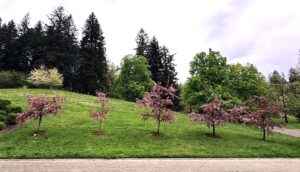
As you enter the ‘spiral’ of the memorial, take in the sweeping views of color and texture all around. 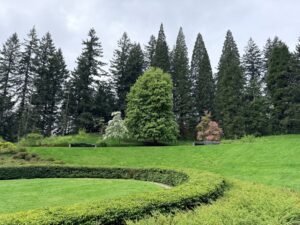
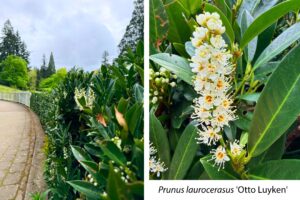
Crossing the footbridge, there is a lovely row of blooming cherry laurel, or Prunus laurocerasus ‘Otto Luyken’.
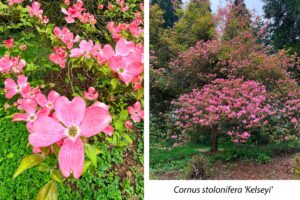
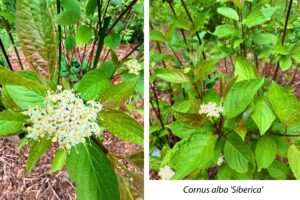
As you wind through the memorial, dogwoods become the featured flora. But don’t be fooled, the showy ‘petals’ of dogwoods are not actually part of the flower- they just surround the tiny little center blooms. Some dogwoods have the modified bracts, like , while others like Cornus alba ‘Siberica’ do not.
Tuesday, April 14, 2026
Even with the return of chilly weather and rain this week, spring blossoms show no signs of slowing down! In fact, you don’t even have to go far from the parking lot and the Visitor Center to enjoy a feast for your senses.
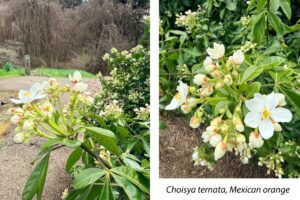
Planted throughout the bioswale and along the margins of the parking lot leading to Beech Trail, Choisya ternata, or Mexican orange may, in fact be, the signature scent of spring at the Arboretum. This shrub is an excellent buffer region plant due to its hardiness and abundant blooms and foliage.
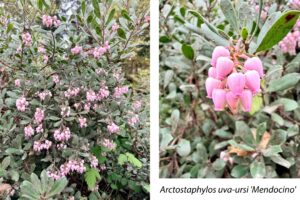
Along the sloping side of the main parking lot, unique manzanita relatives are starting to bloom. Arctostaphylos uva-ursi ‘Mendocino’ are hardy, low-growing evergreen shrubs that thrive in rocky, well-draining soil and prevent erosion on hillsides. Their blooms are white-tinged-pink and bell shaped, supporting a range of bees, butterflies, and hummingbirds.
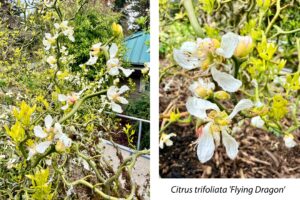
Leading toward the Visitor Center between the ramp and the stairs, another unique shrub is beginning to unfurl its white blossoms. Citrus trifoliata ‘Flying Dragon’, is a slow-growing deciduous shrub known for its contorted, twisted branches and large, curved thorns resembling dragon claws. Its blooms are small, fragrant, and white and are highly attractive to bees and are followed by fuzzy, dark green fruits that turn yellow in autumn.
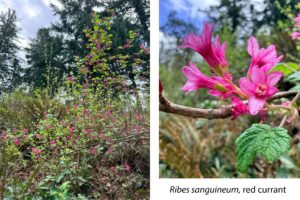
Crossing the street toward Stevens Pavilion, large red-flowering currant, Ribes sanguineum shrubs are particularly eye catching this week against the grey background. These bright early-bloomers can be found all over the park in the understory, but also make great, hardy buffer shrubs around parking lots, roads, and trails.
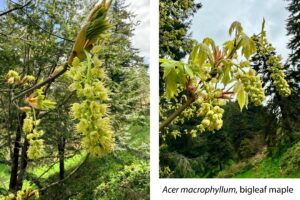
And perhaps the most abundant blooms in the park right now, and a main culprit in local pollen allergies is Acer macrophyllum, the bigleaf maple! Drooping, yellowish-green, fragrant flower clusters are edible and sweet-tasting- a popular preparation as fritters.
Tuesday, April 7, 2026
Blooms along the Magnolia Trail are still going strong, with many of the early-spring-bloomers now also leafing out. Many magnolias are “precocious bloomers” meaning they bloom before they leaf, but even as many are leafing, the blooms are holding on.
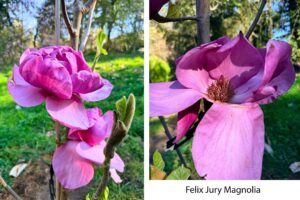
One of the most recent additions to the Magnolia Trail is Magnolia sp. ‘Felix Jury’ or “Felix Jury Magnolia”, which is an award-winning cultivar bred in New Zealand. It has absolutely gigantic, bright pink blooms, even on the very young tree that was only just planted earlier this spring.
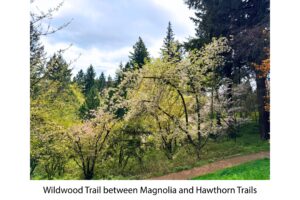
Following the Magnolia Trail switchbacks up the hill will lead you to Wildwood Trail into the heart of Hoyt Arboretum’s flowering cherry collection. Just past the water tank to the right, take the lower path of Wildwood Trail to explore the fragrant and still-blooming flowering cherries tucked with tall conifers and native plants.
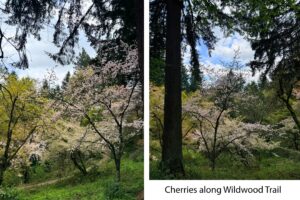
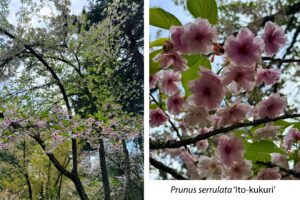
Just across from the bench along the start of this trail is a particularly beautiful Prunus serrulata ‘Ito-kukuri’.
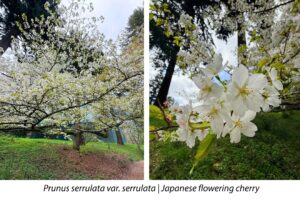
And looping back past the water tank on the other side, is a grand, white-flowering cherry worth stopping under to hear the sound of bees safely occupied with foraging for nectar in the copious blooms above. This is Prunus serrulata var. serrulata or the Japanese flowering cherry.
Monday, March 30, 2026
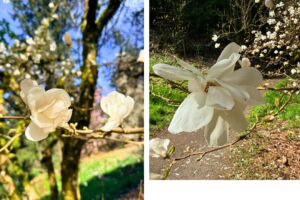
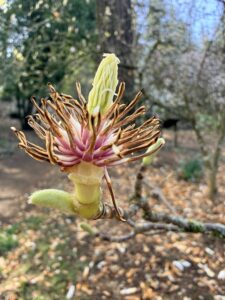 At Hoyt Arboretum, there isn’t just one “peak bloom.” With more than 143 magnolia trees including 42 species and 34 cultivars from around the world, the collections are designed to bloom in succession offering new highlights week by week rather than a single, fleeting moment.
As early blooming species, like this ‘Yulan magnolia’ start to lose their petals (revealing their beautiful reproductive structures), others are just beginning to bloom. This week, the Magnolia Trail is particularly exquisite with big creamy white, pink, purple, and red blooms.
We can expect magnolias to continue blooming at Hoyt Arboretum through the month of April and into May, but the largest overlap of blooming trees along Magnolia Trail is beginning now.
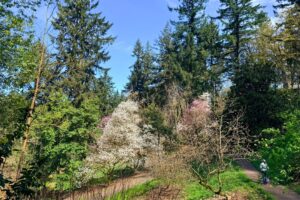
Some highlights include:
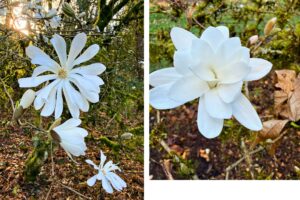
Magnolia x loebneri ‘Leonard Messel’
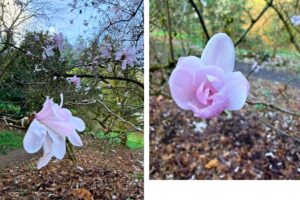
Magnolia stellata – Star Magnolia
Magnolia x soulangiana ‘Alba Superba’ – white magnolia
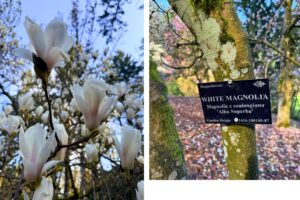
Magnolia × soulangeana – saucer magnolia
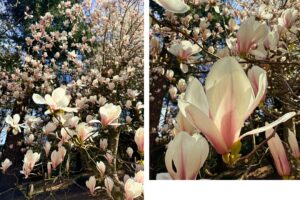
Magnolia × loebneri ‘Dr. Merrill’
Monday, March 23, 2026
With magnolias blooming all over Portland in yards and along the roads, we’ve been getting a lot of questions about how Magnolia Trail is looking.
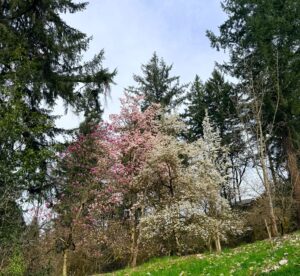
Since the Arboretum is at a higher elevation than city center, our magnolias start blooming a little later in the season, but as of this week, many of the big fuzzy, swollen buds have burst in magnificent blooms.
As you approach Magnolia Trail from Beech Trail across Upper Cascade Dr, the blooms are just visible between the still-bare branches of the beech trees. As you get closer, the colorful blooms light up the hillsides along the trail in brilliant pink and white blossoms.
Many magnolias bloom before they leaf out, and the blooms clustered around bare branches like cotton candy.
Hoyt Arboretum’s Magnolia Trail is designed and planted to bloom in succession, usually from late March until early summer.
Right now, the early-blooming varieties include:
Magnolia liliiflora x veitchii ‘Royal Crown’
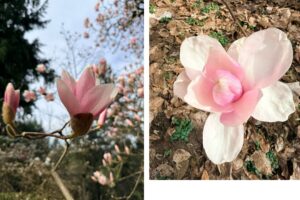
Magnolia kobus – Kobus magnolia
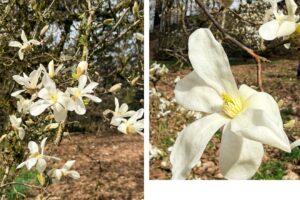
Magnolia denudata – Yulan magnolia
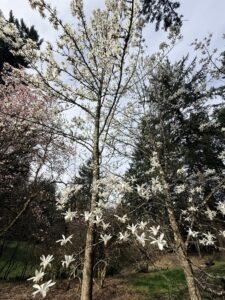
Magnolia liliiflora ‘Purpurea’
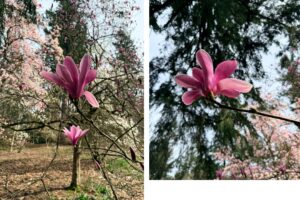
Monday, March 16, 2026
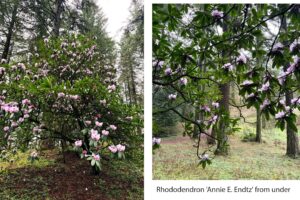
It is a beautiful time of year to explore Wildwood and White Pine Trail. Everything is lush, green, and the fresh scents of early spring are in the air. The wildflowers that pop-up trail side in this season have not yet begun to bloom, but as you cross Fairview Blvd from White Pine Trail and head down toward the Vietnam Veterans Memorial of Oregon a single, stunningly-large Rhododendron “tree” deserves a spotlight of its own.
This is Rhododendron ‘Geraldii’.
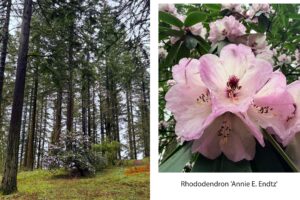
This year the shrub promises to bloom abundantly and for a long time. It is already absolutely covered in clusters of papery white-pink-purple blooms at branch tips, and sports many more hot-pink buds ready to burst.
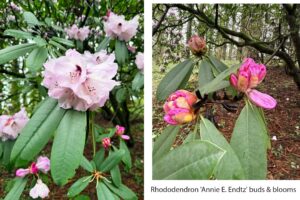
Venture off the trail to get up close to the spectacle, and for a real treat, crouch under the protective branches and look up and out.
Monday, March 9, 2026
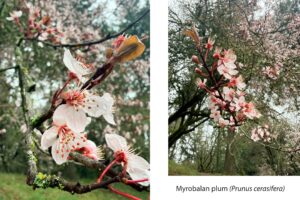
One of the clearest signs that spring is upon us is when the Rosacea Collection along Wildwood Trail between Overlook Tail and Hawthorn Trail begins to bloom. Right near the Water Tank east of Overlook Trail along Wildwood, there are some impressive pink and white blooming trees. They look very similar to cherries, and are closely related, but the impressive display of our “cherry bowl” in this region has not quite begun. These are Myrobalan plums (Prunus cerasifera).
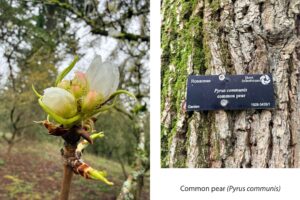
Following Wildwood Toward Hawthorn Trail alongside the water tank, some lovely white flowers begin to emerge on two Common pear (Pyrus communis).
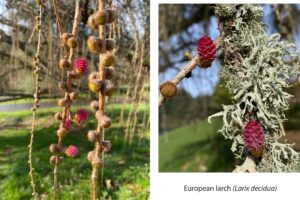
If one were to pick up Overlook Trail from Hawthorn Trail, one would come upon a lovely tree with weeping branches. The branches are sprouting short, bright green needle-like leaves, and a pink pop of color. These young European larch (Larix decidua) cones are not blossoms, but still a colorful symbol of the changing season.
Monday, March 2, 2026
It may seem wrong to start a Spring Blossom Tracker with a Winter Garden highlight, but this section of the Arboretum has some of the best displays of early spring.
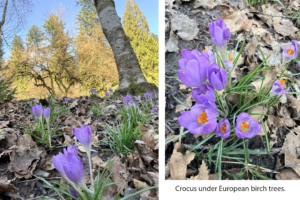
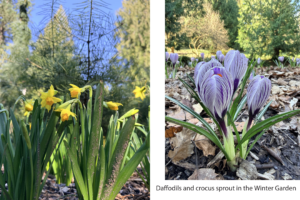
Bulb flowers like crocus and daffodils are starting to pop up and bloom among the landscape of the Winter Garden.
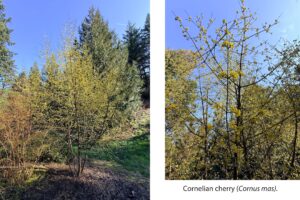
Deeper in the winter Garden a strong, sweet fragrance overpowers the senses. Cornelian cherry (Cornus mas) blooms in bright yellow to the right of the path as you enter from Beech Trail across Upper Cascade Drive.
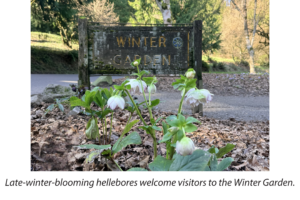
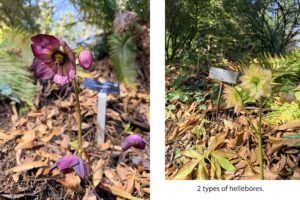
As you head toward Wildwood Trail from the main Winter Garden path, you’ll see 2 types of hellebores signaling the end of winter and the beginning of spring. Helleborus orientalis, a bright purple bloom and Helleborus foetidus, a light, cream-colored with pink accents.
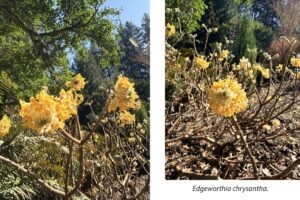
Around the bed and looping back along Upper Cascade Dr back toward Beech Trail, there are some sweet-smelling shrubs with yellow (Edgeworthia chrysantha) and orange (Edgeworthia chrysantha ‘Akebono’) blooms.
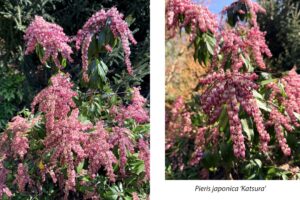
Last, but not least, and nearby, a little further back in the same cluster of plantings, there is a glorious shrub with drooping bell-shaped pink flowers. This is Pieris japonica ‘Katsura’.
Stay Up to Date this Season at Hoyt Arboretum
Check back here for weekly updates on spring blossoms.
Subscribe to our email newsletter
AND
Follow us on Instagram and Facebook